A gardener in London measures the year in four chapters. Spring is bulbs — snowdrops in February, daffodils in March, tulips through April into May. Summer is the herbaceous border in full riot, delphiniums and roses and peonies tumbling over each other in the long June light. Autumn is the slow burn of the trees, the garden withdrawing into structure and seed heads. Winter is quiet — a time for reading catalogues and sharpening tools. The rhythm is written into the culture. It is reliable. It makes sense.
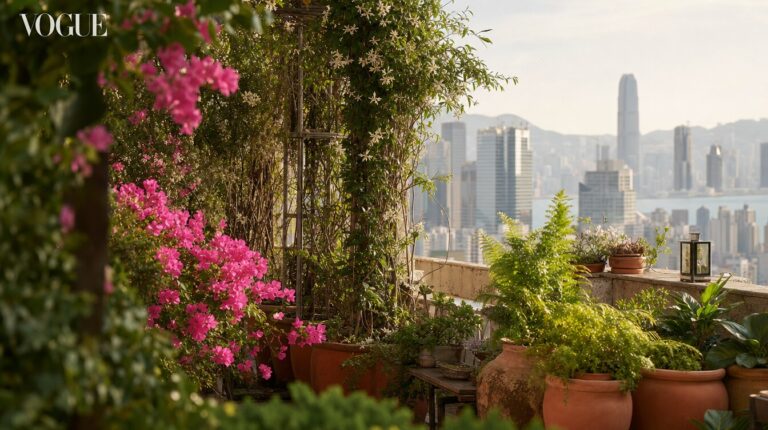
A gardener in Hong Kong has no such calendar. We do not get autumn in the European sense — there is no crisp transition from russet to frost, no first morning when you step outside and smell the cold coming. What we get instead is something subtler, harder to name, and considerably more interesting once you learn to read it. We get micro-seasons — brief windows of two or three weeks where a particular flower peaks, a particular light quality prevails, a particular humidity level makes certain gardening tasks possible and others foolish. The Hong Kong gardening year is not a book with four chapters. It is a poem in forty stanzas, and you have to learn the language before you can appreciate the verse.
The first thing to understand is that Hong Kong’s climate is controlled not by temperature but by water. The year divides into the dry season — roughly October through March, when the northeast monsoon brings cool, clear days and the humidity drops to levels that Europeans would call comfortable — and the wet season, April through September, when the southwest monsoon delivers the kind of humidity that makes paper curl, wood swell, and gardeners question their life choices. Within these two broad seasons, the micro-seasons unfold with a precision that surprised me when I first started paying attention.
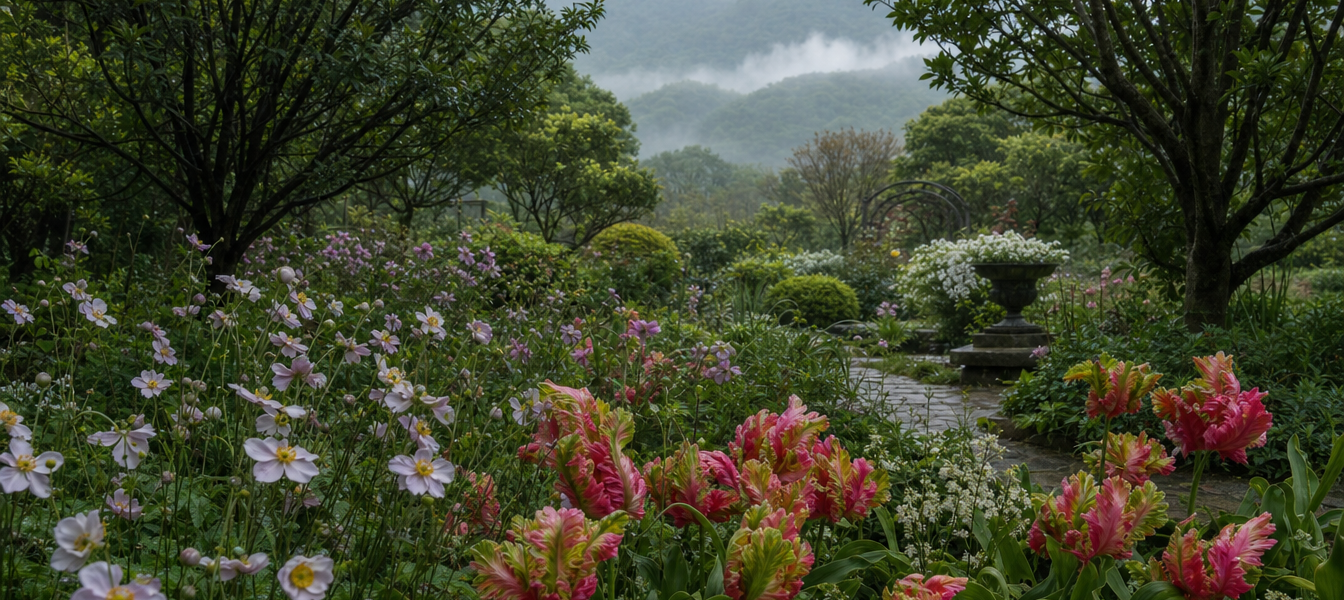
October brings the Japanese anemones, their pale pink and white flowers floating on stems a metre tall, catching the low golden light of autumn afternoons. They bloom for perhaps four weeks, and during those four weeks they are the most beautiful plants in any Hong Kong garden that grows them. By mid-November they are finished, and you will not see them again for eleven months. This brevity is not a flaw. It is the point. Flowers that bloom all year become wallpaper. Flowers that bloom for three weeks become an event.
December through February is the season of the parrot tulip — that extraordinary Dutch creation with petals that look like they have been painted by a Flemish master on a bender, all crimson streaks and green flames and feathered edges. They arrive at the wholesale flower market in January, having been forced in Dutch greenhouses and flown halfway around the world, and they vanish by March. They are absurd, extravagant, and completely unsuited to Hong Kong’s climate — which is precisely why they are so beloved. The parrot tulip is not a sensible flower. It is a declaration.
March and April belong to the delphiniums — those towering spires of blue that look like they belong in an English cottage garden but somehow appear, improbably, in the cool weeks between the last typhoon and the first heatwave. They are difficult in Hong Kong. They need staking against the spring winds, they resent the sudden temperature spikes, and they will collapse dramatically if you look at them wrong. When they succeed, which is about two years out of three, they are magnificent. When they fail, they teach you humility. Both outcomes have value.
The wet season is not a dead zone for flowers, as people sometimes assume. It is the season of the lotus, which rises from muddy ponds in June and July with a serenity that belies the chaos of its growing conditions. It is the season of the frangipani, whose fragrance intensifies in humidity until a single tree can perfume an entire garden. It is the season of the ginger lily, the torch ginger, the heliconia — all those tropical flowers that laugh at the heat and demand nothing but water and patience. The wet season garden is not a European garden. It is something else entirely — lush, rampant, almost indecent in its fecundity. It requires a different aesthetic. You cannot impose order on a tropical garden in July. You can only participate in its exuberance.
Learning to garden in Hong Kong means learning to read these micro-seasons the way a sailor reads the wind — not as obstacles to be overcome but as conditions to be worked with. It means knowing that the Japanese anemones will peak in the second week of October, so you plan your garden visit for that week or you miss them for another year. It means knowing that the parrot tulips are at the market in January, not February, so you go early and you go often. It means accepting that some plants will die — the delphinium that collapsed in April, the rose that black-spotted in June — and that their deaths are not failures. They are data. They are the garden telling you what it can and cannot do, and a good gardener listens.
The European gardening calendar is a novel — a linear narrative with a beginning, a middle, and an end. The Hong Kong gardening calendar is a cycle of poems — each one complete in itself, each one recurring annually but never quite the same way twice. I have come to prefer it. The four-season model is comfortable. The forty-stanza model is alive. It keeps you paying attention. And paying attention, in the end, is what gardening is.