The Invitation
It began, as these things often do, with a dinner party. Sarah and Michael Leung had invited eight friends to their Central flat — a generously proportioned two-bedroom on the eighteenth floor of a 1970s tower block — and at some point between the second bottle of Puligny-Montrachet and the cheese course, someone stepped onto the balcony and asked the question that would change everything. “Why,” their guest asked, gesturing at the expanse of bare concrete and the single plastic chair that constituted the Leungs’ outdoor space, “is this not a garden?”
It was not an unreasonable question. The balcony measured four hundred square feet, which is larger than many Hong Kong studio apartments. It faced southwest, catching the best of the afternoon light. And it was, at that moment, doing absolutely nothing. Michael, an architect by training, had always meant to do something with it. Sarah, a landscape designer who had spent ten years working on the mega-projects of the Pearl River Delta — the kilometre-long parkways, the wetland restorations, the riverfront promenades — had somehow never turned her professional gaze on her own home. They had lived in the flat for six years. The balcony had always been next month’s project.
The Brief
The following weekend, over dim sum at Lung King Heen, they sketched out what they wanted on the back of a paper placemat. It was not, by their own admission, a modest list. They wanted a place to eat outdoors — a proper dining table, not a folding one. They wanted somewhere to sit and read on Sunday mornings, with enough shade that the book didn’t become a sweat-soaked mess by page three. They wanted herbs and salad greens, because Sarah cooked and Michael believed, with the fervour of the recently converted, that nothing tasted as good as something you had grown yourself. They wanted the garden to feel like a room — an extension of the flat, not an afterthought bolted onto its exterior. And they wanted it to survive August.
That last condition, for anyone who has gardened in Hong Kong, is the one that separates the serious from the fantastical. August on a southwest-facing balcony means temperatures that hover above thirty-three degrees Celsius for weeks at a time, humidity that makes the air feel like warm soup, and the occasional typhoon that can turn an unsecured pot into a missile. Most balcony gardens in this city fail not because of neglect but because of August. The heat burns the leaves. The humidity breeds fungus. The wind tears the trellises. By September, the pots are full of brown sticks and the gardener is full of regret.
The Leungs’ placemat plan had three zones — dining, lounging, growing — arranged along a gentle diagonal that made the space feel longer than it was. They drew a pergola. They drew raised beds. They drew a small water feature, because Michael had read somewhere that the sound of running water lowers cortisol levels, and Sarah had replied that anything that lowered her cortisol levels after a day of client meetings was worth whatever it cost. The placemat was stained with chili oil by the time they finished. It was, Michael later said, the most productive dim sum they had ever eaten.
The First Principle: Weight
If there is one thing the Leungs’ garden teaches, it is that weight matters. Not the weight of the plants — the plants can be anything you like — but the weight of the containers. On a high-rise balcony, a lightweight plastic pot is a liability. It blows over. It dries out in hours. It looks cheap, and it makes everything planted in it look cheap by association. The Leungs spent more on their pots than on their plants, and they were right to do so.
They chose terracotta — proper Italian terracotta from Impruneta, the kind that frosts over with a pale grey-green patina after a season or two of rain. Each pot weighs between thirty and eighty kilograms empty. Once filled with soil and plants, some of them top a hundred kilograms. This is not a problem, Michael explained, because the building was constructed in 1974, when structural engineers overbuilt everything, and the balcony slab can carry four times what they have placed on it. But it is worth checking, if you are planning something similar, because not every balcony is a 1974 balcony. The rule of thumb: consult a structural engineer before you fill your outdoor space with a tonne of wet earth. Better to know than to explain to your downstairs neighbour why their ceiling has a new skylight.
Plants That Earn Their Place
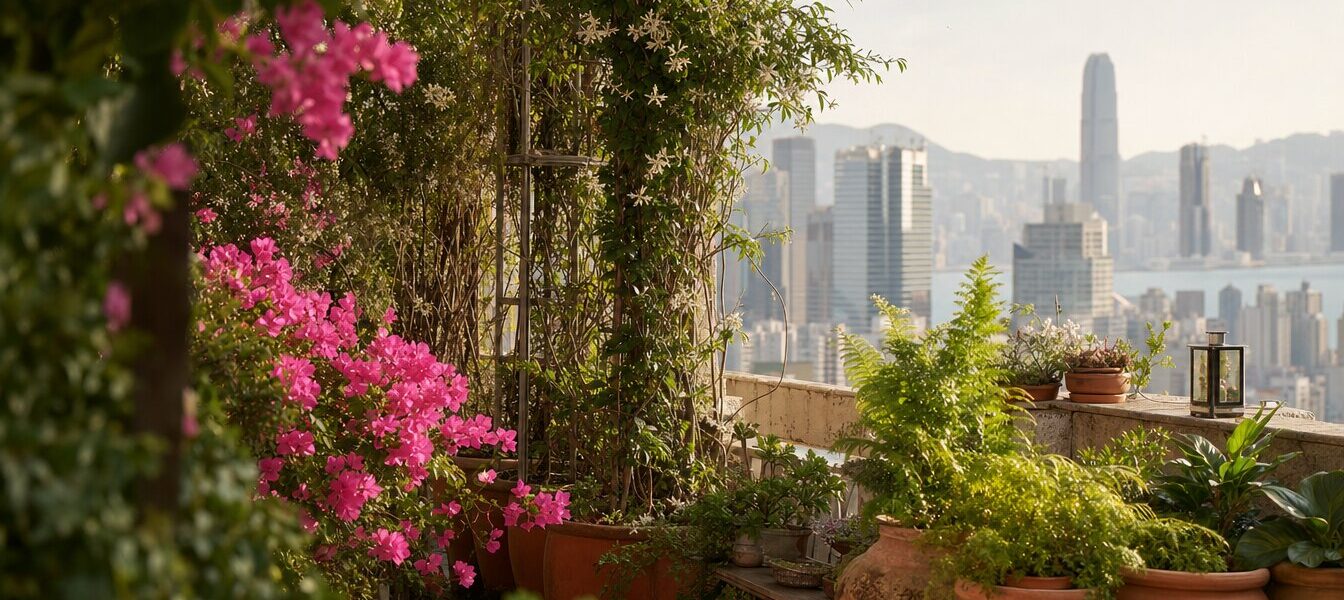
Sarah approached the planting the way she approaches a client project: with a strict plant palette and no room for sentimentality. Every plant had to do at least two things. The frangipani in the largest pot provides shade in summer, fragrance in spring, and sculptural bare branches in winter — three seasons of purpose from a single tree. The climbing star jasmine on the pergola smells like honey in April and creates a green ceiling by June. The agapanthus punctuates the beds with spheres of blue in midsummer and stands as a structural seedhead through autumn and winter, catching the low afternoon light.
The herbs — Thai basil, sweet basil, rosemary, oregano, mint — are grown in a dedicated raised bed at waist height, so Sarah can harvest them without bending. This is a small thing, but small things matter in a small garden. The mint is confined to its own pot within the bed, because mint is a thug that will colonise every cubic centimetre of soil it can reach, and the Leungs learned this the hard way in their first year, when they planted it directly in the bed and spent the next six months pulling runners out of the rosemary. “It was like whack-a-mole,” Sarah said. “But with herbs.”
The Microclimate Nobody Talks About
Eighteen floors up, the wind is different. It gusts. It swirls. It hits the building and rebounds, creating eddies that can strip the leaves off a banana plant in an afternoon. The Leungs’ solution was a living windbreak: a double row of bamboo in rectangular planters along the balcony’s exposed edge, dense enough to knock the wind down to a breeze but not so dense that it blocks the view. Behind the bamboo, the garden sits in a pocket of still air. You can light a candle out there on an ordinarily windy evening, and the flame will barely flicker. This is the kind of detail that doesn’t photograph well but defines whether a garden is pleasant to sit in or merely pleasant to look at from inside.
Watering is automated, because it has to be. A drip-irrigation system runs from a tap on the balcony wall, controlled by a timer that Sarah adjusts seasonally — every other day in winter, twice a day in July and August. The system cost less than the dinner party that started the whole project, and it has saved more plants than Sarah can count. “The single best investment,” she said, “in any balcony garden anywhere in the subtropics.”
The Dinner Party, Revisited
Eighteen months after the first dinner party, the Leungs hosted another. The same eight friends came, and this time, nobody asked why the balcony wasn’t a garden. They ate at a teak table under a canopy of jasmine, with the lights of Central flickering on as the evening deepened. The frangipani was in bloom. The water feature — a simple stone basin with a recirculating pump — made the sound Michael had wanted, a quiet trickle that seemed to lower the temperature by several degrees even though it obviously didn’t. Someone asked how much the whole thing had cost, and Sarah said, “Less than a car and more than a handbag,” which is the kind of answer that tells you everything and nothing.
The garden has now survived two Augusts. The bougainvillea has reached the pergola. The herbs have supplied a hundred meals. And the plastic chair — the one that used to sit alone on the bare concrete — has been relegated to the storage cupboard, where it belongs. The Leungs’ rooftop garden is not the largest garden in Hong Kong, or the most expensive, or the most impressive. But it is theirs, and it works, and that, in the end, is the only brief that matters.