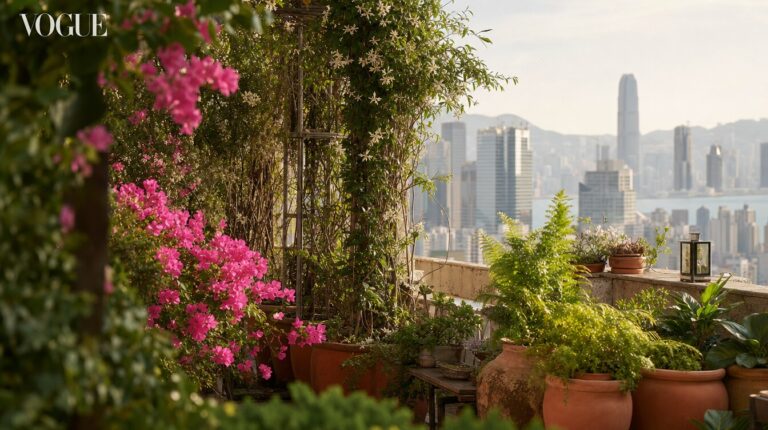
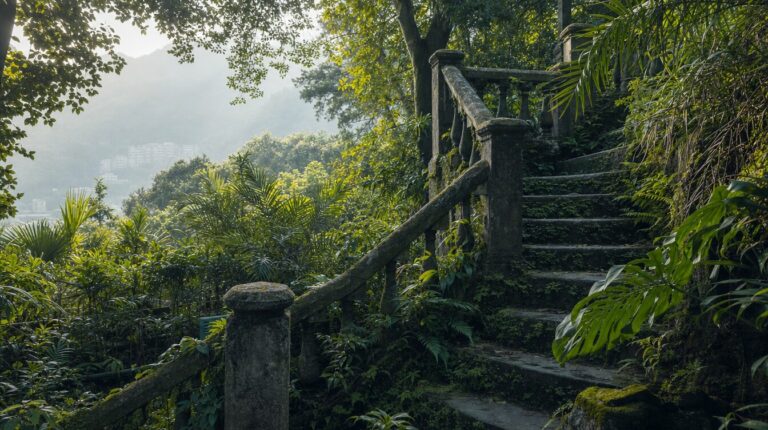
On a Tuesday morning in late February, at an hour when Central is still rubbing sleep from its eyes, the village of Lam Tsuen is already three hours into its working day. The air smells of turned earth and something sweet — Osmanthus fragrans, planted as a windbreak along the field boundaries, its tiny white flowers pumping out that apricot-jam scent that every Hong Kong grandmother recognises. Clementina Lau Yuen-ting straightens up from a row of Matthiola incana, brushes soil from her knees, and squints at the sky. “The light’s changing,” she says. “We have maybe forty minutes before the heat hits the stock and the stems start to soften.” She is twenty-nine years old, holds a degree in environmental science from the University of Hong Kong, and she is one of the most interesting flower farmers in the city that most people assume has no flower farmers at all.
That assumption — that Hong Kong grows nothing but concrete — is the starting point for a quiet agricultural revival that has been unfolding in the New Territories over the past decade. While the city’s flower markets have long been dominated by imports flown in from Holland, Kenya, and Kunming, a small but determined cohort of growers has been proving that Hong Kong soil, Hong Kong light, and Hong Kong seasons can produce flowers that do not merely compete with the imports but — in the right hands — surpass them. This is not a story about nostalgia. It is a story about soil chemistry, microclimate mapping, direct-to-consumer distribution models, and the radical proposition that a city of seven million people can also be a city that grows things.
The Soil That Everyone Forgot
To understand why flower farming in Hong Kong is both improbable and quietly thriving, you have to understand the soil. The New Territories are underlain by decomposed granite and volcanic tuff — acidic, fast-draining, and in many places so shallow that you hit bedrock before your spade is halfway in. This is not, by any conventional measure, prime agricultural land. The alluvial plains of the Netherlands can offer two metres of silty loam. The volcanic soils of Ecuador’s rose country are famously rich in potassium and phosphorus. Hong Kong offers lateritic clay that bakes to the consistency of terracotta in the dry season and turns to slurry when the monsoon arrives.
And yet. “Granitic soil is not the problem people think it is,” says Dr. Philip Chan, a soil scientist at the Kadoorie Farm and Botanic Garden who has spent fifteen years studying the agricultural potential of Hong Kong’s abandoned farmland. “The drainage is actually excellent for cut flowers. What’s missing is organic matter — and that’s fixable.” Chan’s research, published in a series of papers that exactly nobody outside a small circle of soil nerds has read, demonstrates that adding a 15-centimetre layer of composted green waste — produced in industrial quantities by Hong Kong’s parks department and mostly sent to landfill — transforms New Territories soil within a single growing season. “We have the amendment. We just don’t use it.”
The farmers who are using it tend to be young, formally educated, and entirely unsentimental about agriculture. Clementina Lau’s three dou — about 2,000 square metres — in Lam Tsuen were abandoned rice paddies when she leased them in 2022. The soil pH was 4.8. The organic matter content was below 1%. “My first soil test came back and I genuinely laughed,” she says. “The report might as well have said ‘this is not soil, this is rubble with ambition.'” She spent her first six months doing nothing but amending: twenty tonnes of composted horse manure from the Beas River equestrian centre, biochar produced from orchard prunings at a nearby lychee farm, and regular applications of liquid seaweed extract that she ferments herself in four blue drums behind her packing shed. By the 2023-24 cool season, her Ranunculus asiaticus — the tissue-paper-petalled Italian hybrids that are standard-bearers for any serious cut-flower operation — were producing stems at 60 centimetres, comparable to imports from Kunming.
Who Farms Flowers in Hong Kong, and Why
The stereotype of the Hong Kong farmer is a seventy-year-old man in a straw hat, tending his vegetable plot with the weary persistence of someone who has been doing this since the Japanese occupation and isn’t about to stop now. And there are still plenty of those. Walk through the fields around Fanling on a weekday morning and you will see elderly farmers bent over rows of Brassica chinensis, their plots — often a single dou or less — producing the choi sum and white cabbage that end up in wet markets by lunchtime.
The flower farmers are different. They are, overwhelmingly, under forty. Many have degrees. Several have left careers in finance, law, or architecture. They discovered flower farming not as a birthright — most did not grow up on farms — but as a deliberate, researched, almost obsessive choice. They read Floret’s books and watched YouTube videos of Erin Benzakein walking through her Washington fields. They did internships on flower farms in Japan and Taiwan. They came back to Hong Kong convinced that something interesting was possible here, in the neglected corners of the northern New Territories, on land that developers had not yet managed to rezone.
Take Marcus Cheung, thirty-three, who spent seven years as an associate at a Big Four accounting firm before walking away in 2021 to start what he calls, with characteristic precision, “a vertically integrated micro-floriculture enterprise” on two dou near Sheung Shui. He grows exclusively for the restaurant trade: edible flowers and aromatic herbs delivered within four hours of cutting to kitchens in Central and Kennedy Town. His clients include three Michelin-starred restaurants, none of which he will name — “that’s up to them” — but all of which pay a premium for Borago officinalis flowers that still carry morning dew, Tropaeolum majus leaves that haven’t begun to wilt, and Calendula officinalis petals separated by hand and packed in single-layer trays so they don’t bruise.
“The economics are insane, obviously,” Cheung says, standing in a polytunnel that cost him HK$80,000 to build and will take, by his own calculation, “about seven years” to pay back. “But the restaurants don’t care about the economics. They care that my borage flowers arrive looking like they were painted that morning. Kunming borage — if it arrives at all — looks like it’s been sat on.” He pauses. “Also, I was very bored of auditing.”
The Varieties That Work (and the Ones That Don’t)
Not everything grows in Hong Kong. This seems obvious, but the early years of the flower-farming revival were littered with expensive failures based on the assumption that subtropical heat plus irrigation equals anything-goes. It does not. The summer monsoon — hot, wet, and relentless from May through September — kills most cool-season annuals within a week. Fungal diseases spread through Dahlia plantings like fire through dry grass. Paeonia (peonies) will not flower without winter chilling hours that Hong Kong simply does not provide, no matter how many hopeful gardeners plant them and wait.
What does work, according to the farmers who have spent years learning through attrition, falls into three categories. First: the winter cool-season annuals that can be started in October, grown through the mild dry season, and harvested from January through April — Ranunculus asiaticus, Anemone coronaria, Matthiola incana (stock), Lathyrus odoratus (sweet pea), Antirrhinum majus (snapdragon), and the indispensable Nigella damascena. These are the bread-and-butter flowers, the ones that florists need in volume for weddings and events, and they grow beautifully in Hong Kong’s winter — provided the soil has been properly amended and the grower is willing to cover entire fields with shade cloth when a warm spell pushes daytime temperatures above 25°C.
Second: the subtropical perennials that handle the summer. Zingiber species, particularly the shell ginger (Alpinia zerumbet) with its pendulous pink-and-white inflorescences, thrive in the humidity. Heliconia — the lobster-claw flowers that look like they belong in a Rainforest Café but are actually sophisticated structural elements in the right hands — produce steadily from April through November. Curcuma (Siam tulip) is emerging as a signature crop for several growers: it tolerates wet feet, produces in partial shade, and its pink bracts last two weeks in the vase. And Nelumbo nucifera, the sacred lotus, grows in flooded containers at Cheung’s farm, producing seed pods that restaurants pay absurd prices for — HK$40 per pod — because they’re impossible to import fresh.
Third: the heat-tolerant foliage plants. Asparagus setaceus (asparagus fern), Eucalyptus cinerea (silver dollar gum), and various Pittosporum cultivars provide the greenery that every arrangement needs and that Hong Kong florists currently import from Yunnan at three times the cost of production. “Foliage is the smart money,” says Lau. “Everyone wants to grow peonies because they’re romantic. But you can’t grow peonies here. You can grow the most beautiful Eucalyptus anyone has ever seen, and florists will buy every branch you can cut.”
The Direct-to-Consumer Model That Actually Works
The traditional flower supply chain is brutal. A stem cut in Kunming on Monday is trucked to Shenzhen, clears customs, reaches the Mong Kok flower market by Wednesday, sits in a wholesaler’s bucket until Thursday, and arrives at a florist’s shop on Friday — at which point it has spent five days out of water or in questionable hydration. The vase life is half what it should be. The price has quadrupled. Everyone in the chain is unhappy except the logistics companies.
Hong Kong’s micro-flower-farmers have built an alternative that is so simple it borders on obvious: they sell directly to consumers through Instagram and WhatsApp. No wholesalers. No markets. No middlemen. A farmer posts a photo of that week’s harvest on Sunday evening. Customers message their orders. On Tuesday morning, the flowers are cut at dawn, conditioned in cool water for four hours, and delivered by lunchtime — either by the farmer personally, by a fleet of Lalamove drivers, or, in an increasingly common arrangement, to collection points at independent coffee shops in Central, Causeway Bay, and Kennedy Town where customers pick up their bouquets alongside their flat whites.
“The economics of this are not just ‘a bit better,'” says Cheung, who tracks everything in spreadsheets because he cannot help himself. “They are transformative.” A bunch of ten ranunculus stems from Kunming, purchased by a florist, will have changed hands at least four times and cost approximately HK$120. Lau’s ranunculus, sold directly to a customer through her Instagram account @clementina.flowers, sells for HK$180 — a 50% premium — and the customer receives stems that were cut six hours ago, not six days. “People pay for freshness,” she says. “They also pay for the story. When I deliver flowers to someone in Mid-Levels and they ask me ‘where did these come from,’ I can say ‘from my field in Lam Tsuen, this morning, and by the way the variety is called La Belle and it was bred in Italy in 2015.’ That’s not a transaction. That’s a relationship.”
The numbers are small — Lau’s customer list is around 400 people, Cheung’s restaurant client base is twelve — but the trajectory is unmistakable. Several farmers report that their 2025-26 season revenue exceeded their previous corporate salaries. This is partly because Hong Kong is a city where a certain demographic will pay HK$200 for a bouquet without blinking, but it is also because the direct model eliminates every cost between production and consumption except transportation. No wholesaler markup. No market stall rent. No waste from unsold stock — every stem is spoken for before it’s cut.
The Land Problem
If there is one thing that keeps Hong Kong’s flower farmers awake at night — and there are several — it is land. Specifically, the near-impossibility of securing long-term agricultural tenure in a city where every square metre of flat land is a potential development site and the government’s land policy is, to put it generously, inconsistent.
Most of the New Territories’ agricultural land is held under Block Crown Lease, a colonial-era tenure system that permits farming but offers no security against resumption by the government. A farmer can invest five years in building soil, installing irrigation, and planting perennials, only to receive a notice that the land is being resumed for a public housing project or — more commonly — sold to a developer who will leave it fallow while waiting for the right moment to apply for a change of use. This is not a hypothetical scenario. It happened to two flower farms in the Kam Tin area in 2024. Both had been operating for less than three years. Neither received compensation for the loss of their perennial plantings.
“The message from the government is: we want young people to go into agriculture, but we also want to build flats, and we haven’t decided which is more important,” says Dr. Chan. “So the farmer gets caught in the middle, and the developer wins.” He is not being cynical. He is being accurate.
Some farmers have found creative workarounds. Sarah Wong, who grows Cosmos, Zinnia, and Helianthus on a quarter-dou plot in Pat Heung, leases her land from a village elder under an informal arrangement that has no legal standing but has held for four years on the strength of mutual trust and a shared enthusiasm for Dahlia breeding. “He brings me tea,” she says. “I bring him dahlias. Neither of us has signed anything.” This is charming but precarious, and everyone in the farming community knows it. The solution that most farmers want — a dedicated agricultural land bank with ten-year renewable leases at below-market rates — has been proposed by legislative councillors, endorsed by agricultural bodies, and ignored by every administration since 2012.
In the meantime, the farmers adapt. Container gardening, rooftop growing, and vertical systems are all being explored. Marcus Cheung is experimenting with hydroponic cut-flower production in a warehouse in Kwai Chung — “ugly as hell,” he admits, “but nobody’s going to resume a Kwai Chung industrial building for a public housing project” — and has successfully grown Freesia and Ranunculus under LED lights. The quality is not yet where he wants it, but he is, characteristically, running the numbers: energy cost per stem, yield per square metre, payback period on the LED array. “Give me two years,” he says. “If the economics work, I’ll never touch soil again.”
The Restaurants and the Florists
The most visible evidence of the flower-farming revival is not in the fields themselves but in the places that buy from them. Walk into any of the better restaurants in Central on a Thursday evening and look at the flowers. If the arrangement on the maître d’s desk includes shell ginger that has not yet fully opened, or ranunculus whose petals still carry the slight translucence of that morning’s dew, or a single stem of Nelumbo seed pod that looks less like a flower and more like a sculpture — that arrangement almost certainly came from a New Territories farm.
The florists who buy locally are a small but influential group. Jennifer Li of Bloom & Stem, a studio in Sheung Wan that supplies flowers for some of the city’s most photographed weddings, sources roughly 30% of her materials from local growers during the cool season. “The difference between a Clementina ranunculus and an import is not subtle,” she says. “The import is a commodity. It’s been bred for transport, not for beauty. The petals are thicker, the stems are shorter, the colours are whatever the Dutch auction wanted that week. Clementina’s ranunculus are bred for Italian gardens. They’re fragile and impractical and they last six days in the vase instead of ten, but they are — forgive me — genuinely beautiful. They look like a painting.”
Li’s clients don’t ask where the flowers come from, she says. They ask for that specific softness — “like a watercolour,” one bride’s brief specified — and the local flowers deliver it precisely because they haven’t been hardened for a five-day supply chain. “Brides don’t know they want local flowers,” Li says. “They just know they want flowers that don’t look like they came from a supermarket. And the local ones don’t.”
The restaurant chefs are even more direct. “Imported edible flowers are a gamble,” says the head chef of a two-Michelin-starred restaurant in Central who agreed to speak on condition that neither he nor the restaurant be named. “You order nasturtium leaves and they arrive brown at the edges. You order borage and half the flowers are crushed. With Marcus, I get a WhatsApp at 7 a.m. saying ‘cutting now, see you at 11,’ and at 11:15 I have a box of flowers that look like they’ve never been touched by human hands.” He pauses. “Also, he understands that I need exactly thirty-two borage flowers for a specific dish, and he counts them. Every time.”
What This Means for Gardeners
You do not need two dou of agricultural land to participate in this revival. You need a balcony, a rooftop, or a windowsill — and a willingness to kill some plants while you learn which ones want to live.
The lesson of the New Territories flower farmers for the home gardener is straightforward: grow what works in your conditions, not what you wish would work. If you have a south-facing balcony in Sai Kung, you can grow Zinnia elegans in summer and Matthiola incana in winter, and both will produce flowers you can cut for the house. If you have a shaded north-facing windowsill, stop trying to grow roses and start growing Aspidistra elatior — the cast-iron plant that survived Victorian parlours and will survive your neglect too. If you have a rooftop, invest in windbreaks before you invest in plants; the prevailing easterly will shred anything over 40 centimetres unless you protect it.
Start with soil. Clementina Lau’s rule — “spend your first budget on amendments, not on plants” — applies just as much to a 40-centimetre pot as to a field. A bag of good compost costs HK$60. A bag of perlite for drainage costs HK$40. Together they will transform a pot of Hong Kong’s native clay into something plants actually want to grow in. “People spend HK$300 on a plant and put it in the cheapest soil they can find,” Lau says. “That’s like buying a Chanel jacket and wearing it with plastic flip-flops. The foundation is everything.”
Secondly, water in the morning. The science is unequivocal: watering between 6 a.m. and 8 a.m. gives foliage time to dry before the heat of the day, which reduces fungal disease; it means water is available to the plant when photosynthesis begins; and it avoids the evening-watering trap of leaving roots sitting in moisture overnight, which encourages root rot. “I cannot tell you how many people water their plants at 9 p.m. because that’s when they get home from work,” says Dr. Chan. “And then they wonder why everything dies. Water in the morning, or don’t water at all.”
Thirdly, accept that summer is a fallow season. The subtropical monsoon is not a growing season; it is a survival season. The flower farmers of the New Territories use July, August, and September for soil amendment, infrastructure repair, seed ordering, and rest. So should you. “Summer is not for growing. Summer is for planning what you’ll grow in October,” says Cheung. “Anyone who tells you otherwise is selling you something.”
The Quiet Revolution
On a Saturday morning in March, Clementina Lau’s Lam Tsuen field is full of people who are not farmers. There is a woman from Tai Po who saw Lau’s Instagram and wanted to know if she could grow ranunculus on her balcony (answer: yes, in a deep pot, with morning sun, and do not overwater). There is a couple from Yuen Long who are thinking about leasing a small plot and want to see what a working flower farm looks like. There is a florist from Wan Chai who has been buying from Lau for two seasons and has never actually visited the field where her stock is grown; she is wandering between the rows with the slightly dazed expression of someone who has just discovered that flowers come from the ground.
This is the quiet revolution. It is not measured in hectares or tonnes. It is measured in WhatsApp groups that light up at dawn with photos of that day’s harvest, in restaurant dishes garnished with flowers grown 30 kilometres from the kitchen, in brides who carry bouquets of ranunculus that have never been on an aeroplane, and in the slow, patient, almost invisible work of people who have decided that a city of seven million can also be a city that grows things worth picking.
Lau cuts a stem of Anemone coronaria — the variety is ‘Mount Everest’, white with a green centre — and holds it up to the light. “Look at the back of the petals,” she says. “See the veining? That’s a sign of good calcium uptake. It means the soil is right. It took me two years to get the soil right.” She puts the stem in a bucket of water with the careful precision of someone handling a Fabergé egg, then looks up at the sky again. The light is soft now, late-afternoon gold, the best light for cutting. She has perhaps another hour before she needs to get everything into the cool room. Behind her, the Shenzhen skyline is turning pink in the sunset. In front of her, a field of anemones is nodding in the breeze. “People think Hong Kong doesn’t grow flowers,” she says. “I think Hong Kong grows the best flowers in the world. They just don’t know it yet.”