What the Hill Remembers
The first time I walked Lugard Road, I was looking for the view and found the trees instead. This is the predictable trajectory of anyone who sets out on the Peak’s most famous circuit — you go for the harbour, the skyline, the Instagram-ready panorama of one of the world’s most photographed cities — and somewhere between the third and fourth switchback, distracted by a banyan root thicker than your thigh or a camphor tree that smells, improbably, of childhood cough medicine, you forget to look at the view at all.
Lugard Road is Hong Kong’s most walked path and its least examined landscape. Two million people complete this circuit every year — joggers in the humid dawn, couples on Sunday afternoons, tourists who have read about it on a travel blog and are surprised to discover it’s a real road with a real name. Almost none of them realise they are walking through a garden. A garden that has been growing, mostly unattended, for a hundred and fifty years.
This is not a metaphor. The trees, shrubs, and understory plants that line Lugard Road are not remnant woodland — they are the survivors of a deliberate planting programme that began in the 1870s, when the Peak was being transformed from a barren, windswept ridge into the summer refuge of colonial Hong Kong. What looks like “nature” on Lugard Road is actually a curated collection — a living museum of nineteenth-century botanical taste, tropical forestry experiments, and the particular horticultural obsessions of a handful of British civil servants who thought that what Hong Kong really needed was more camellias.
This article is a detective story. It’s about what was planted, what survived, and what the plants of Lugard Road can tell us — if we learn to read them — about Hong Kong’s botanical DNA. It is also, unavoidably, about empire and ecology, about the plants that colonial powers moved around the world like chess pieces, and about the quiet violence of a landscape that no longer belongs entirely to the place where it grows.
The Botanical Footprint of Empire
To understand what grows on Lugard Road, you have to understand the Peak before there was a Lugard Road. Before 1870, the Peak was essentially a rock with grass on it. Early photographs — and Hong Kong was photographed obsessively almost from the moment the British arrived — show a bald ridge, denuded by centuries of hill fires and soil erosion, with barely a tree above the 200-metre contour. The Chinese called it “the mountain of the fierce wind” and had the good sense to leave it alone. The British, finding themselves in possession of a subtropical port where summer temperatures routinely exceeded 33 degrees with humidity to match, looked at that windswept ridge and saw salvation.
The Peak Reservation Ordinance of 1904 — which formally restricted residence on the Peak to Europeans — is well known. Less known is the planting programme that preceded it by three decades and that was, in its own way, just as much an instrument of colonial place-making. The first trees on the Peak were not ornamental. They were functional: fast-growing Australian acacias and eucalypts planted to stabilise slopes, provide shade, and, perhaps most importantly, make the place look less foreign. A bare Chinese hillside was threatening. A wooded hill, planted with familiar species from other parts of the empire, was reassuring. The landscape itself was being colonised.
The man most responsible for this transformation was Charles Ford, Hong Kong’s first Superintendent of the Botanical and Forestry Department, appointed in 1871. Ford was not a great botanist — his contemporaries described him, with the particular cruelty of Victorian scientists, as “a competent plantsman” — but he was a tireless planter. Under his direction, the hillsides above Central were terraced and planted with a blend of species drawn from Kew’s network of colonial botanic gardens: banyans from Calcutta, camphor trees from Taiwan, Norfolk Island pines from the South Pacific, and the inevitable Australian gums that were, by the 1880s, the default landscaping tree of the British Empire from Cape Town to Singapore.
By the time Ford died in 1901, he had overseen the planting of an estimated 750,000 trees across Hong Kong Island. A significant proportion of those — perhaps as many as 50,000 — were planted on the slopes that Lugard Road would eventually traverse. When the road itself was built between 1913 and 1921 (named for Sir Frederick Lugard, the governor who had authorised its construction), it was cut through a maturing woodland that was already twenty to forty years old. The road didn’t create the garden. It revealed it.
The Banyan That Outlived Everyone
If Lugard Road has a signature plant, it is the Chinese banyan, Ficus microcarpa. You cannot walk a hundred metres without encountering one. Some are modest — waist-high shrubs erupting from cracks in the stone retaining walls, opportunistic seedlings that found a foothold and refused to let go. Others are cathedral-scale: trees whose aerial roots have fused into multiple trunks, whose canopies span twenty metres, and whose root systems have, with the slow patience of the genuinely immovable, absorbed entire sections of the stonework that was meant to contain them.
The largest banyan on Lugard Road — I will not tell you exactly where; finding it is half the pleasure — is almost certainly older than the road itself. Its main trunk, measured at breast height, exceeds three metres in diameter, which puts it at approximately 130 to 150 years old. This tree was already a substantial specimen when the road builders came through. They could have removed it. Instead, they curved the road around it. Someone — we don’t know who — made the decision that this tree was worth preserving. It is the only architectural decision made on Lugard Road in the twentieth century that has aged well.
The banyan’s success on the Peak is not an accident. Ficus microcarpa is what botanists call a strangler fig: its seeds germinate in the crooks of other trees or in cracks in walls, sending roots downward and branches upward, eventually enveloping whatever supported it. In a tropical rainforest, a strangler fig will eventually kill its host tree and stand in its place, a hollow cylinder of living wood. On Lugard Road, the banyans’ hosts are not trees but walls — the granite and concrete retaining structures that hold the hillside in place. The banyans don’t kill their hosts; they become them. The wall and the tree fuse into a single organism. The distinction between the built and the grown dissolves.
There is a lesson here about what actually thrives in Hong Kong’s climate. The colonial planters brought species from every continent, carefully selected for their suitability to “tropical” conditions as understood by nineteenth-century European botanists. Most of those introductions failed. The banyan, which required no introduction at all — it was here long before the British — succeeded brilliantly, not despite the colonial infrastructure but because of it. Every stone wall, every drainage channel, every terrace provided a new niche for a plant that had evolved to exploit exactly these kinds of disturbed, human-modified environments. The planters thought they were creating a garden. They were actually creating a banyan nursery.
Reading the Landscape: A Walking Guide to What Survived
If you walk Lugard Road with a botanically educated eye — or, more practically, with a plant identification app and a willingness to look slightly eccentric — you can piece together the planting history like an archaeologist reading strata. The surviving species fall into three rough categories, and each tells a different story.
The Triumphs. These are plants that not only survived but naturalised — species that have established self-sustaining populations and are now, for all practical purposes, part of Hong Kong’s wild flora. The top performers are almost all Asian natives: Ficus microcarpa (Chinese banyan), Cinnamomum camphora (camphor tree), Bauhinia × blakeana (Hong Kong orchid tree — though this is a twentieth-century addition, not a colonial original), Livistona chinensis (Chinese fan palm), and Michelia figo (banana shrub, whose small cream flowers release a fragrance that stops walkers in their tracks every March). These species didn’t need the British to succeed in Hong Kong. They were already here, or nearly here. The colonial planting programme simply gave them a head start on a hillside that had been stripped bare.
The Holdouts. These are species that persist as individual specimens — sometimes magnificent ones — but have never established self-sustaining populations. They exist only where they were planted. The Norfolk Island pines (Araucaria heterophylla) are the most visible example: those distinctive, geometric silhouettes that punctuate the Peak skyline. They are not reproducing. Every Norfolk Island pine on the Peak is a direct descendant — in the horticultural sense — of a tree that somebody put in the ground a century ago. Other holdouts include the Queensland kauri (Agathis robusta), several specimens of which survive in the more sheltered gullies, and the occasional poinciana (Delonix regia), which flowers dramatically but briefly in June and July, a burst of scarlet that is entirely incongruous with the surrounding greens and greys.
The Ghosts. These are the species we know were planted because the records survive — the Botanical and Forestry Department kept meticulous annual reports — but that have vanished entirely. The most poignant losses are the Himalayan rhododendrons (Rhododendron arboreum), which were planted in significant numbers in the 1890s in the hope of creating something resembling a Himalayan hillside. Every single one died within a decade. Hong Kong’s winters are simply not cold enough to trigger the flowering cycle, and the relentless humidity of the summer monsoon encourages fungal diseases that rhododendrons have no resistance to. Also lost: the English oaks (Quercus robur) that some homesick official ordered in bulk in 1882, the Monterey pines (Pinus radiata) that couldn’t handle the typhoon season, and the Japanese maples that lasted exactly one summer before succumbing to root rot.
There is a practical lesson in this triage for anyone planting in Hong Kong today. The successes are almost all broadleaf evergreens from warm-temperate to subtropical Asia. The failures are from places with cold winters, dry summers, or both. The Peak’s elevation — 400 to 550 metres — provides some relief from the worst of the lowland heat, but it is fundamentally a subtropical maritime climate with high humidity, frequent typhoons, and no real winter dormancy period. Plants that require a cold rest period will die here. Plants that can’t handle fungal pressure will die here. The colonial planters learned this through trial and expensive error. You can learn it for free by walking Lugard Road and noting what’s still standing.
The Gardeners of the Peak
Behind every surviving plant on Lugard Road is a person whose name we will almost certainly never know. The British superintendents — Ford, his successor William Tutcher, the formidable Geoffrey Herklots who ran Hong Kong University’s botany department in the 1930s — left records. The Chinese gardeners who did the actual planting left almost nothing. We know they existed because the payroll records survive: in 1895, the Botanical and Forestry Department employed forty-seven Chinese gardeners, each earning between eight and twelve dollars a month. Their names are listed in the colonial gazette — Chan A-tai, Wong A-fook, Lee A-sang — but nothing else. We don’t know where they came from, what they knew about plants before they were hired, or what they thought about the species they were asked to plant.
This absence matters, because it is almost certain that the Peak’s planting programme succeeded partly because of knowledge that flowed upward, from the gardeners to their supervisors, rather than the reverse. Any experienced gardener in nineteenth-century Guangdong would have understood, far better than a botanist trained at Kew, which species could survive a South China summer. The banyan’s ubiquity on the Peak is probably not solely the result of colonial planning decisions. It is more likely that the gardeners, planting the specimens they were told to plant, also planted — or at least protected — the species they knew would thrive.
There is a tantalising fragment of evidence for this. In 1903, Charles Ford’s annual report notes, with some puzzlement, that “a number of specimens of the Lichee have been observed establishing themselves on the upper slopes, apparently from seeds discarded by picnickers.” The lychee (Litchi chinensis) was not on any official planting list. It was a fruit tree, not an ornamental, and it had no place in a European-style woodland garden. But it was — and is — one of the most important fruit trees in South China. Somebody was planting lychees on the Peak, and it wasn’t the British. It was almost certainly the gardeners, supplementing the official programme with their own choices, creating a landscape that was more Cantonese than the colonial administrators ever realised.
Today, several mature lychee trees survive in the less-trafficked sections above Lugard Road, their presence unremarked by the thousands of walkers who pass beneath them each week. If you know when to look — late May to early June — you can see the fruit ripening, small and slightly underdeveloped compared to the orchard-grown specimens in the New Territories, but unmistakably lychees. They are the living signature of gardeners whose names we have lost.
What the Lost Gardens Tell Us About Hong Kong’s Botanical DNA
The most interesting question about Lugard Road is not “what was planted here?” but “why does it matter now?” The answer has less to do with heritage — colonial nostalgia is, at best, a complicated position in contemporary Hong Kong — and more to do with ecology, resilience, and the future of urban planting in a rapidly warming city.
The Peak’s colonial-era plantings constitute what ecologists call a “novel ecosystem”: a community of species that would never have occurred together naturally, assembled by human intervention, that has since developed its own internal dynamics and stability. Novel ecosystems are often dismissed by conservation biologists — they are not “native,” not “natural,” not “authentic” — but they are increasingly the only ecosystems we have. In a city where 75% of the land area is country park (a statistic that surprises almost everyone who only knows Hong Kong from its skyline), understanding how introduced species integrate with native ones is not an academic exercise. It’s a practical necessity.
Consider the camphor trees. Cinnamomum camphora is native to southern China, including Hong Kong, but it was never common on the Peak before the colonial plantings. The pre-colonial vegetation at that elevation was primarily shrubland — Baeckea frutescens, Rhodomyrtus tomentosa, and various grasses maintained by periodic burning. The camphor trees that now dominate large sections of the upper Peak are, in a strict sense, introduced — they were brought up from lower elevations by human intervention. But they are also native to the territory. They belong here, just not here specifically.
This blurry line between native and introduced is the reality of urban ecology in the Anthropocene. The Peak’s plant community is a hybrid — Chinese natives, Asian introductions, and a sprinkling of genuinely exotic species from Australia, Africa, and the Americas — that has been sorting itself out for a century and a half. The result is a landscape that is more diverse, more resilient, and arguably more interesting than the original shrubland it replaced. It supports bird species that would not otherwise breed at this elevation. It provides a refuge for orchids and ferns that have been extirpated from the lowlands by development. It cools the microclimate measurably: temperature readings on the Peak are consistently 3–5 degrees lower than in Central, and the tree cover accounts for roughly half of that difference.
The practical implication for Hong Kong gardeners is clear: the most resilient planting palettes borrow from multiple biogeographic regions. Mediterranean plants like rosemary and lavender will struggle in the summer monsoon, but they’ll thrive on a south-facing balcony from October to April. Australian plants like Grevillea and Callistemon are adapted to poor soils and long dry periods. Southeast Asian understory plants like Aglaonema and various ferns handle deep shade and humidity. The Lugard Road garden, for all its colonial origins, is a working demonstration of this principle: the plants that survived weren’t the ones that came from the most prestigious botanical gardens. They were the ones that happened to find Hong Kong’s particular combination of heat, humidity, wind, and soil to their liking.
A Walk Through December
One of the privileges of living in Hong Kong is that you can walk Lugard Road in any month of the year and find something growing. December is the best month, though, and if you only walk it once, walk it in December. The air is clear — the pollution from the Pearl River Delta factories drops with the winter monsoon — and the light has a particular quality, low and golden from about three in the afternoon, that makes every leaf look like it has been individually polished.
The camphor trees are at their best in December. The new foliage, which appears in November, has hardened off to a deep, glossy green. If you crush a leaf — gently; the tree deserves better, but you need to smell it at least once — the aroma is medicinal, clean, slightly sharp. Camphor was once one of the most valuable commodities in East Asian trade, used in everything from embalming to explosives. The trees on Lugard Road have never been harvested; they are too inaccessible, too beloved, too much a part of the landscape. They are among the few camphor trees in the world that will die of old age.
Below the camphors, in the shadier sections near the old signal station, the ferns are at their peak. The bird’s nest ferns (Asplenium nidus) that grow in the crooks of the banyans are plump with December moisture. The stag’s horn ferns (Platycerium bifurcatum) — not native, but introduced so long ago that they might as well be — are putting out new fronds, the sterile ones pressing flat against the bark like green shields. It’s worth stopping here, not for a photograph but for a minute of stillness. The Peak in December is alive with the sound of birds that have come down from higher elevations: Japanese white-eyes, Chinese bulbuls, the occasional black-faced laughingthrush. The city is two kilometres and a hundred years away.
I have been walking Lugard Road for fifteen years, and I have never walked it the same way twice. The garden changes by the month, by the season, by the particular quality of light on a particular afternoon. A tree that was unremarkable in August is spectacular in December. A slope that seemed bare in March is carpeted with ferns by May. This is the point of a garden — any garden — and it is a point that the colonial planters understood, even if they would have expressed it differently. A garden is not a painting. It does not hold still. It is a living system that you enter, and that enters you, and that is never quite finished.
How to Walk Lugard Road Like a Gardener
If this article has persuaded you to walk Lugard Road with fresh eyes — or for the first time — here is the practical information that most guides omit.
Timing. Go early. The road opens at all hours (it is, despite the name, a pedestrian-only path), and the light between six-thirty and eight in the morning is worth the early alarm. The air is cooler, the birds are more active, and you will share the path with perhaps a dozen other people rather than several hundred. If you cannot face the early start, late afternoon — from about three-thirty onwards, depending on the season — offers the best light for looking at plants rather than at views.
Direction. Start at the Peak Tower end and walk clockwise. This puts the most dramatic banyans and camphor trees in the first half of the walk, when your attention is freshest, and saves the harbour views for the return leg, when you’ll be ready for them. The full circuit is 3.5 kilometres and takes roughly an hour at a walking pace, but you should budget at least ninety minutes if you plan to stop and look at plants. Budget two hours if you plan to stop and look at plants and also carry a camera. Budget three hours if you are a gardener, because you will inevitably stop to examine the root structure of every third banyan.
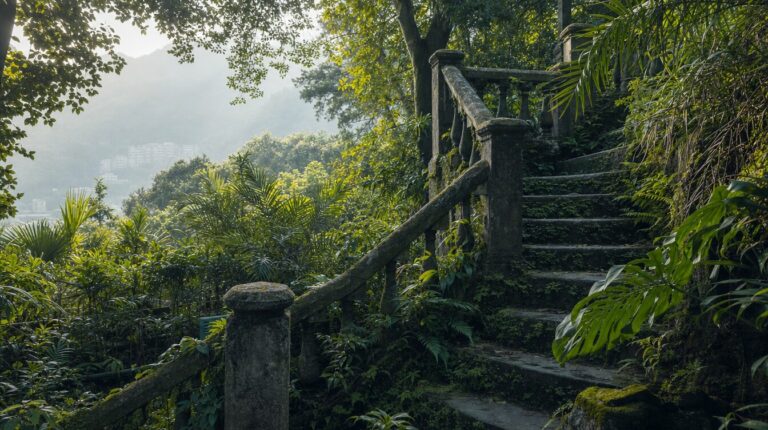
What to bring. Binoculars are more useful than a camera for seeing what’s growing on the slopes above and below the path. A plant identification app — iNaturalist is free and surprisingly good for Hong Kong flora — will answer most of your “what is that?” questions. Water is essential; there are no shops or vending machines on the circuit. Do not wear open-toed shoes. The path is paved and well-maintained, but the stone steps that descend to the less-visited side paths are often slick with moss and leaf litter.
What to look for. The banyans are unmissable. The camphor trees are almost as conspicuous — look for the ones with trunks that appear to be wrapped in rough, vertically fissured bark. The Norfolk Island pines are the tall, symmetrical ones that look like they belong on a Christmas card. The surprises are smaller: the banana shrub (Michelia figo) in March, the wild orchids (Dendrobium species) that grow on the older banyans, the lychee trees whose presence is a gift from gardeners whose names we will never recover.
The Garden Without a Gardener
In 2024, a tree failed on Lugard Road — a Chinese banyan, one of the oldest, brought down by a typhoon that had weakened a root plate already compromised by a season of heavy rain. The government arborists came and removed the fallen sections, cut back the damaged limbs, and left the rest. A year later, the tree was sending out new shoots. A banyan does not die easily.
I went to see the damaged tree a few weeks after the typhoon. The loss was substantial — perhaps a third of the canopy was gone — but what remained was still alive, still photosynthesising, still doing what a tree does. Around the base, the soil that had been torn up by the root plate was already colonised by ferns. The process of repair had begun before the humans arrived with their chainsaws.
This is the thing about the garden on Lugard Road: it does not need us. The colonial administrators who created it are dead. The Chinese gardeners who maintained it are dead. The policies that shaped it — the Peak Reservation, the afforestation programmes, the very idea that a hillside in subtropical Asia should look like an English woodland — have been discredited or abandoned or simply forgotten. But the plants remain, doing what plants do: growing, competing, dying, regenerating, assembling themselves into a community that no one designed and no one controls.
This is, I think, the real lesson of the lost gardens. Not that colonial horticulture left a benign legacy — the politics of the Peak’s landscaping are too fraught for that — but that plants outlast politics. The garden on Lugard Road is older than the People’s Republic of China, older than the Japanese occupation, older than the lease that returned Hong Kong to Chinese sovereignty. It is older than almost everything in Hong Kong except the rocks. And it will still be growing, in some form, long after the city below has been rebuilt yet again.
A garden without a gardener is not a garden in the conventional sense. It is something wilder, more interesting, more honest. It is a record of what was tried, what failed, what refused to die. It is a document written in wood and leaf and root. It is, if you know how to read it, the most reliable history of this city that exists. Walk it slowly. It has things to tell you.