The Road That Time Forgot
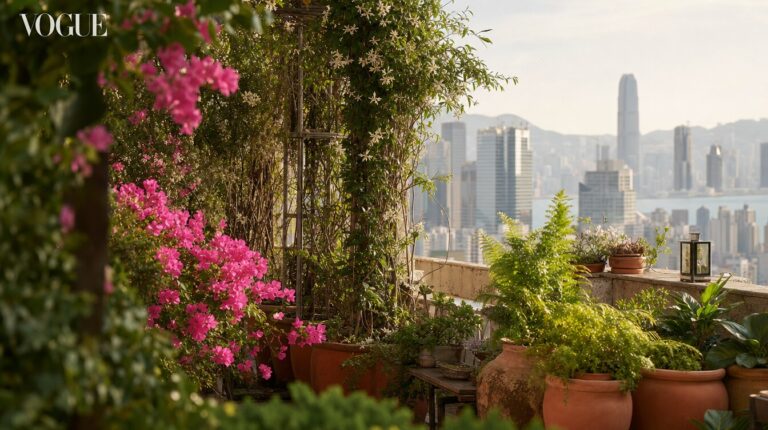
Lugard Road is not, strictly speaking, a road. It is a path — a narrow, paved circuit that wraps around the upper shoulder of Victoria Peak at just under four hundred metres above sea level, offering what is universally acknowledged to be the finest urban panorama in the world. Every day, thousands of people walk it: joggers in neon Lycra, tourists with selfie sticks, elderly couples with matching sun hats and walking poles. Almost none of them notice the gardens. This is surprising, because the gardens of Lugard Road are everywhere. They are simply hiding in plain sight.
To see them, you must stop walking and look down. Not at the view — the view is a distraction, a glittering expanse of harbour and skyscraper that pulls the eye outward and away — but at the ground beneath your feet, at the embankments and cuttings and overgrown terraces that line the path. There, tangled in the undergrowth, are the bones of Hong Kong’s colonial planting heritage: the English ivy and the asparagus fern, the Manila rope and the African tulip tree, the camellias and gardenias planted by gardeners whose names are lost to history.
What the Mountain Remembers
Victoria Peak was not always a public amenity. For most of the nineteenth century, it was a private enclave — a cool refuge for the colonial elite who could afford sedan chairs to carry them up the steep paths from the sweltering city below. The Peak Tram opened in 1888, and with it came a building boom: grand houses with grander gardens, terraced into the hillside, planted with species brought from England and India and the botanic gardens of Singapore. The gardeners were Chinese, mostly, and they knew things about the local soil and climate that their employers did not. They were the ones who figured out which imports would survive the typhoons and which would not. Their knowledge is written in the surviving plants, if you know how to read them.
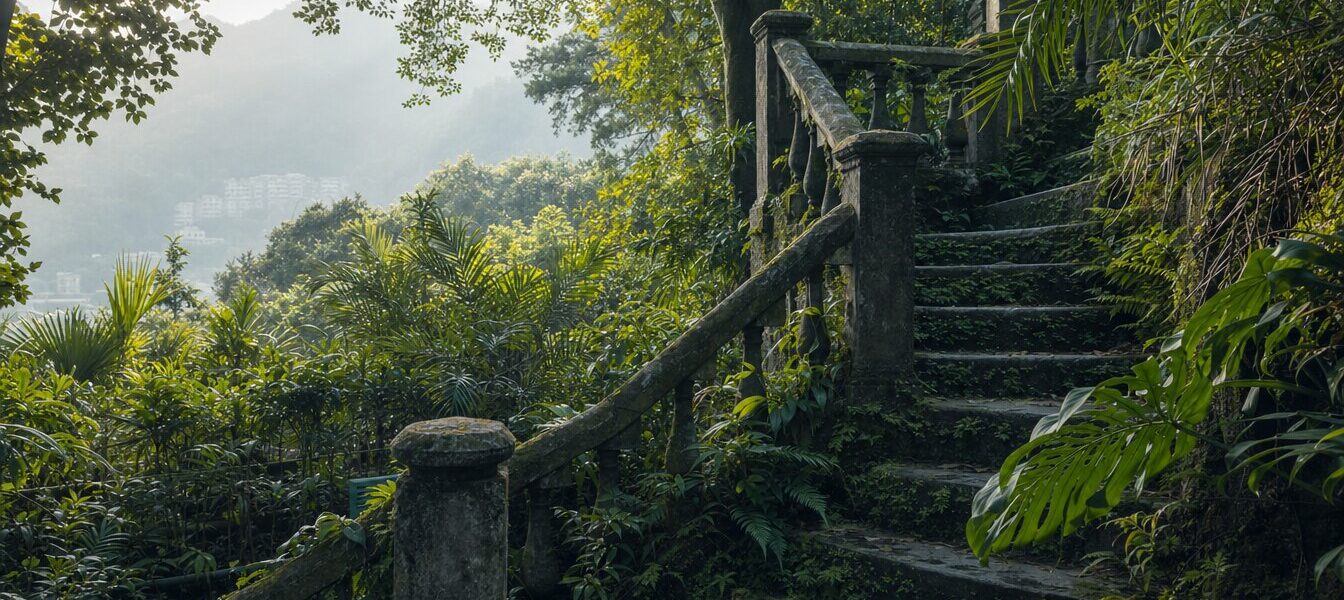
The houses are mostly gone now — demolished and replaced by apartment towers in the 1970s and 1980s, or abandoned and reclaimed by the forest. But the gardens persist. A camellia that was planted in 1923 to mark the birth of a governor’s daughter still flowers every February, even though the house it belonged to was torn down forty years ago. A banyan fig, planted as a sapling in a stone urn, has long since burst the urn and sent aerial roots cascading down the slope, creating its own microclimate. A hedge of gardenia, originally clipped into geometric precision by a team of three gardeners with hand shears, has gone feral — a sprawling, fragrant thicket that blooms with abandon each June, its scent carrying for a hundred metres along the path.
The Plants That Stayed
What survives on Lugard Road is not an intact garden but a palimpsest — a layered record of horticultural decisions made over more than a century, each overlaid on the last. Walk the circuit clockwise from the Peak Tram station and you will encounter, in rough chronological order: the indigenous forest that predates European settlement (machilus, schefflera, the occasional wild rhododendron); the Victorian-era imports (camellia, gardenia, hydrangea, rose); the interwar tropicals (bougainvillea, plumeria, heliconia); and the post-war ground covers, planted to stabilise the slopes after a major landslide in 1966.
The most remarkable survivor is not a single plant but a planting scheme: a stretch of about two hundred metres where someone — no one knows who — planted a sequence of flowering shrubs arranged to bloom in succession from January through May. It begins with camellias in late winter, moves through azaleas in early spring, peaks with rhododendrons in March and April, and ends with gardenias as the rains arrive in May. The effect, if you happen to walk the path at the right pace in the right season, is of a floral narrative unfolding over time: a garden designed to be read, not just seen.
The Invisible Gardeners
Nobody maintains these plants any more. The Leisure and Cultural Services Department sends crews to clear the drains and trim back branches that threaten the path, but they are not gardeners. Their brief is safety, not aesthetics. The plants that survive on Lugard Road are the ones that need no human help — the tough ones, the self-seeders, the species that have figured out how to thrive in thin mountain soil and compete with the relentless growth of the native forest. It is, in its way, a form of natural selection: survival of the most adaptable.
And yet, every so often, evidence of human care appears. A camellia that had been choked by creepers suddenly has a cleared circle of earth around its base. A clump of agapanthus that had been flattened by a fallen branch has been staked upright. The work is anonymous and irregular — the kind of thing a retired person might do on a Tuesday morning, with a pair of secateurs and a deep knowledge of what belongs and what does not. Whoever they are, they are the true inheritors of the colonial gardeners who first shaped this landscape, and their quiet stewardship is the reason these plants are still here.
What a Garden Means When Nobody Owns It
There is a kind of garden that exists only in intention — a garden that was planted, and then abandoned, and then half-reclaimed by the forest, and then half-tended by strangers, until what remains is neither wild nor cultivated but something in between. The Lugard Road gardens are of this kind. They are not anyone’s property. They are not on any heritage register. They have no plaque, no interpretation panel, no mention in the tourist guides. And yet they are, in their way, the most honest gardens in Hong Kong: gardens that have outlived their gardeners, gardens that have proven their fitness by simply refusing to die.
The next time you walk Lugard Road, slow down. Look at the ground. Touch the leaves. Pick up a fallen camellia and examine its petals — they will be the descendants of a plant that someone, more than a century ago, chose to put in the ground because they thought it was beautiful. They were right. It still is.