The Problem with Imported Gardens
May Cheng did not set out to become a garden designer. She trained as an architect at the University of Hong Kong, spent six years designing residential towers in Kwun Tong, and only started thinking seriously about plants when she tried to grow tomatoes on her balcony in Kennedy Town. The tomatoes died. So did the basil. The mint — mint, the plant that is essentially a weed with a PR problem — also died. Most architects would have accepted defeat and bought a succulent. Cheng did what architects do: she treated the failure as a design problem. If she could not grow a tomato on a west-facing balcony twenty storeys above the harbour, she reasoned, there was something wrong with her understanding of the conditions, not with her green thumb. She enrolled in a horticulture certificate at Kadoorie Farm, spent weekends volunteering at the Hong Kong Zoological and Botanical Gardens, and by 2018 had left architecture entirely to establish Studio Cheng — now one of Hong Kong’s most quietly influential garden design practices. Her speciality, if you had to name one, is light.
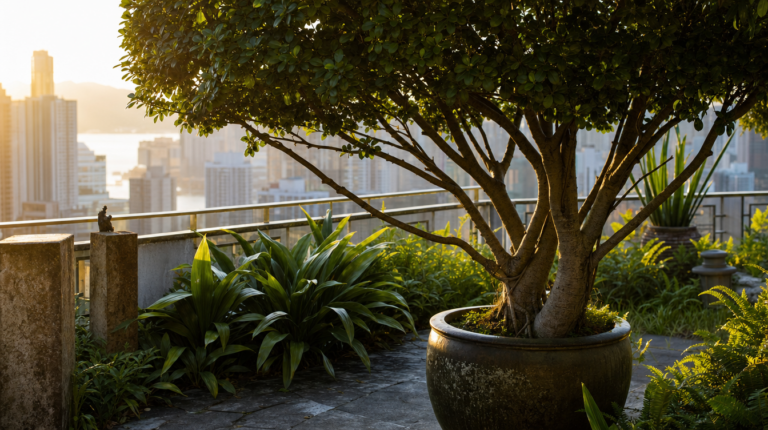
“Hong Kong light is not like English light, or Mediterranean light, or even Singapore light,” she says. “It is sharp, vertical, and reflected. In summer it is brutal for six hours, then gone. In winter it is soft but low — a horizontal light that sneaks under balconies and turns everything gold at four in the afternoon. You cannot design a garden here by copying a garden from somewhere else. You have to design for this light, specifically.”
This philosophy — that light comes first, and everything else follows — has produced some of the most thoughtfully planted spaces in Hong Kong. Cheng’s gardens appear in the portfolios of architects who know enough to bring in a specialist: a Sai Kung courtyard that turns a west-facing heat trap into a dappled evening retreat; a Mid-Levels terrace where an eight-metre-long planter manages to feel like a forest floor despite being suspended forty storeys above Caine Road; a Discovery Bay garden designed entirely around the movement of shadows across a single day. None of these gardens look like anything you would find in a British gardening magazine. None of them look like anything you would find in a Japanese garden book, either, though Cheng’s work is clearly informed by both traditions. They look, instead, like Hong Kong — if Hong Kong had the horticultural self-confidence to stop imitating other climates and start designing for its own.
Learning to See Light
Cheng’s first garden commission came through a former architecture colleague who had bought a village house in Mui Wo and wanted “something green” for the small courtyard. It was a south-facing space, roughly four metres by six, enclosed on three sides by the house walls and open to the south. The previous owner had paved the entire thing in beige ceramic tiles and placed a single potted ficus in the corner. When Cheng visited the site in July, the courtyard was unusable after 10 a.m. — the tiles radiated heat, the walls reflected it, and the ficus was visibly suffering. “It was a kiln,” she recalls. “The tiles were storing heat all day and releasing it all night. The walls were bouncing light around like a mirror box. Nothing was going to grow in there except perhaps a cactus, and even a cactus would have complained.”
Her solution was counterintuitive: she removed the tiles and replaced them with a deep bed of soil — “forty centimetres minimum,” she says, “which the contractor thought was insane” — planted a Bauhinia × blakeana as a canopy tree, and underplanted with Liriope muscari, Aspidistra elatior, and clumps of Alpinia zerumbet. The soil absorbed heat instead of radiating it. The bauhinia cast dappled shade by its second year. The liriope and aspidistra — two of the toughest shade-tolerant plants in existence — thrived in the filtered light. “The client thought I was giving him a garden,” Cheng says. “I was giving him an air conditioner that happened to look like plants.”
This project established what would become Cheng’s signature methodology: before drawing a single plant, she spends a full day on site — ideally twice, once in summer and once in winter — mapping the path of the sun. She draws a diagram in her notebook, hour by hour, marking which walls heat up, which corners stay dark, which patch of ground gets the brutal 2 p.m. overhead sun and which patch gets the gentle 4 p.m. horizontal light. “Most people think about plants first,” she says. “They come to me with a list — ‘I want roses, I want lavender, I want a jacaranda.’ I tell them: let’s talk about the north-east corner of your terrace at 3 p.m. in January. If you get that right, the plants will follow.”
The Plant Palette
Cheng’s planting list is not long. She works with perhaps forty species, repeated in different combinations, at different scales, depending on the light. This is partly a practical constraint — Hong Kong nurseries stock a limited range, and importing from mainland China adds weeks to a timeline — but it is also a design principle. “Variety is overrated,” she says. “Five plants, well-chosen and well-placed, will look better than fifty plants crammed in because someone wanted to collect one of everything. A garden is not a stamp album.”
Her structural plants — the ones that give a garden its bones — include Rhapis excelsa (lady palm), Cycas revoluta (sago palm), and Dracaena marginata, all of which tolerate Hong Kong’s extremes of heat and humidity without complaint. For canopy, she relies heavily on Bauhinia × blakeana, Hong Kong’s floral emblem, which she describes as “the most underrated tree in the territory — everyone sees it on the flag and forgets that it actually performs in a garden.” For screening and vertical structure, Phyllostachys aurea (golden bamboo) appears in almost every project, always contained in buried concrete planters to prevent it from colonising the entire garden — a lesson learned the hard way in an early project where a client called six months after completion to report that bamboo shoots were emerging through the living room floor.
Her ground layer is where the subtlety lives. Ophiopogon japonicus (mondo grass) for deep shade. Zoysia tenuifolia for the small patches of lawn that Hong Kong gardens can actually sustain. Liriope muscari for the edge of paths, where its purple flower spikes catch the low afternoon light. Chlorophytum comosum (spider plant) — “I know, I know, it’s the plant your grandmother had in her kitchen,” she says, pre-empting the objection — “but massed in a shaded corner, ten or twelve of them together, it creates this luminous green pool that looks almost tropical. Don’t dismiss a plant because it’s common. Common plants are common for a reason: they survive.”
For seasonal interest — the hardest thing to achieve in Hong Kong’s climate, where the difference between January and July is less about temperature and more about a slight shift in humidity — she uses Hymenocallis littoralis (beach spider lily) for its dramatic white flowers in late summer, Plumeria rubra (frangipani) for fragrance and sculptural branching, and Hibiscus rosa-sinensis cultivars in deep red and apricot, which flower almost continuously if kept well-watered. “People think you can’t have seasons in Hong Kong,” she says. “You can. You just have to adjust your definition of a season. A frangipani dropping its leaves in December — that’s a season. A spider lily suddenly producing flowers in August, when you’d forgotten you’d even planted it — that’s a season too.”
Designing with the Vertical Light
The challenge of Hong Kong light, Cheng explains, is that it arrives from directly overhead for much of the year. At 22 degrees north of the equator, the midday sun in June is essentially vertical — it falls straight down, creating hard shadows that pool directly beneath plants rather than stretching out behind them. This is the opposite of what most garden design books assume. “Every textbook on garden design was written for a temperate climate,” Cheng says. “They talk about south-facing borders, about catching the low winter sun, about the golden hour. Here, the golden hour in June is about fifteen minutes long and the rest of the day is a interrogation lamp.”
Her response to this has been to develop what she calls “layered shade” — gardens designed not for how they look in full sun, but for how they look in the filtered, reflected light that defines most of a Hong Kong day. A typical Cheng garden has three layers: a canopy layer (the bauhinia or a multi-stemmed Lagerstroemia speciosa) that breaks the direct overhead light; a mid-layer of shrubs and tall grasses (Miscanthus sinensis, Ligustrum sinense ‘Variegatum’) that catch the filtered light on their leaves; and a ground layer that glows in the low, horizontal light of early morning and late afternoon.
“I design gardens for the hours when people actually use them,” she says. “Nobody sits in their garden at noon in August. They sit there at seven in the morning, with coffee, or at five in the afternoon, when the sun has dropped behind the building next door. So I design for seven a.m. and five p.m. The noon garden can take care of itself.”
This pragmatic approach has won her clients who had given up on their outdoor spaces. One Mid-Levels terrace, barely two metres wide and fifteen metres long, faced west and received direct afternoon sun for six hours a day. The previous owners had tried a shade sail (blew away in a typhoon), a retractable awning (moulded within a season), and finally a row of potted Ficus microcarpa (died, one by one, from root-bound stress). Cheng’s solution was a single structural intervention: a steel pergola planted with Mucuna bennettii (red jade vine), which in three years had covered the entire structure. Beneath it, she planted Monstera deliciosa, Calathea orbifolia, and a deep bed of Sphagneticola trilobata as ground cover — all plants that thrive in the dappled, tropical light created by the vine canopy. The terrace went from uninhabitable to the most-used room in the apartment.
The Architect’s Eye
Cheng’s architectural training surfaces in her gardens in ways both obvious and subtle. The obvious way: she draws plans. Real plans, with elevations, sections, and a planting schedule that reads like a construction document. “I’ve had nurseries call me to ask if I’m actually a landscape architect,” she says. “I’m not. I’m an architect who decided that plants are a better building material than concrete.”
The subtle way is harder to describe but more important. It has to do with circulation — the way you move through a space. Cheng’s gardens are never experienced from a single viewpoint. There is always a path, even in the smallest courtyard, that takes you from one place to another. “A garden you look at from the living room window is a painting,” she says. “A garden you walk through is a story. I design stories.”
In a recent project in Shek O — a hillside garden of perhaps 150 square metres, laid out across three terraces — the path begins at the top, by the kitchen door, where a narrow staircase leads down through a grove of Bambusa multiplex ‘Alphonse Karr’ (the yellow-striped bamboo that Cheng uses when she wants something that reads as deliberate rather than merely functional). At the bottom of the stairs, the path turns ninety degrees, and the entire middle terrace opens up — a flat lawn of Zoysia matrella, a single Bauhinia casting shade on a stone bench, and a long view across the South China Sea that you cannot see from anywhere else in the garden. “That moment,” Cheng says, “the reveal — that’s architecture. The plants are the materials, but the experience is the design. And it works because you couldn’t see it coming. A garden that shows you everything at once is a garden with nothing left to discover.”
What She Has Killed, and What It Taught Her
Cheng is unusually candid about her failures — a trait that distinguishes her from many garden designers, who tend to present their work as the inevitable result of expertise. “I have killed hundreds of plants,” she says, without embarrassment. “Thousands, probably. If you have not killed a plant, you have not been gardening long enough.”
The list of species she no longer specifies is long and hard-won. Lavandula angustifolia (English lavender) — “a death sentence in Hong Kong humidity, and yet every client asks for it.” Rosa cultivars that require winter chill — “the David Austin roses are beautiful for about three weeks and then they get black spot and you spend the next eleven months apologising.” Wisteria sinensis — “it grows, but it never flowers. I have seen exactly one wisteria in Hong Kong that flowered properly, and it was on a north-facing wall at 400 metres elevation on the Peak. That is the only place in the territory where wisteria makes sense.” Hydrangea macrophylla — “it works in pots, in shade, with acid soil and daily watering. It does not work in the ground. Anyone who tells you otherwise is selling you something.”
“The most useful thing I can tell a client is ‘that plant will die.’ It’s not what they want to hear. But it saves them two years of watching something struggle, blaming themselves, and eventually paying me to replace it anyway.”
What she has learned to embrace instead are the plants that genuinely belong here. Bauhinia, of course. Michelia × alba (white champaca), for its intoxicating fragrance and its tolerance of heat. Tabernaemontana divaricata (crepe jasmine), which flowers almost year-round and asks for nothing in return. Murraya paniculata (orange jasmine) for hedging — “the scent in the evening is so powerful it drifts through open windows, and it is basically indestructible.” Native Hong Kong species that she wishes more designers would use: Gordonia axillaris (Hong Kong gordonia), with its white camellia-like flowers and its brilliant red autumn leaves — “it does autumn colour in a climate that doesn’t have autumn, which is a kind of miracle”; Rhodoleia championii (Hong Kong rose), whose pendulous pink flowers appear in late winter when almost nothing else is blooming; and Ilex rotunda, an evergreen holly that produces bright red berries and thrives in full sun. “We have native plants that are genuinely beautiful,” she says. “The problem is that nobody knows about them. Nurseries don’t stock them because customers don’t ask for them. Customers don’t ask for them because they’ve never seen them. It’s a loop, and someone has to break it.”
The Future of Hong Kong Garden Design
Cheng believes that Hong Kong garden design is at an inflection point. For decades, she says, the default mode was importation: imported plants, imported design styles, imported assumptions about what a garden should look like. The result was a city full of English cottage gardens dying in the humidity, Japanese rock gardens baking in the sun, and Mediterranean courtyards drowning in the monsoon. “We were designing gardens for a climate that doesn’t exist here,” she says. “And then we were surprised when they failed.”
A younger generation of designers, she believes, is starting to change this. They are looking at Hong Kong’s native flora, at the planting traditions of southern China, at the tropical modernism of Roberto Burle Marx and the ecological approach of Piet Oudolf — and synthesising something new. “The garden design that will come out of Hong Kong in the next ten years,” she predicts, “will be one of the most interesting things happening in the discipline globally. Because we have to solve problems that temperate-zone designers never face. We have to deal with typhoons. We have to deal with six months of heat and humidity. We have to deal with spaces that are tiny and vertical and surrounded by reflective glass. And we have to do it with a plant palette that is completely different from what the textbooks assume. That’s not a limitation. That’s an opportunity.”
Her own studio has grown from a one-person operation to a team of five — two designers, a horticulturist, a project manager, and Cheng herself, who still does every site visit personally. “You cannot design a garden from photographs,” she says. “You have to stand in the space and feel the heat on your skin and see where the shadows fall. Light is not something you can measure with a light meter. It’s something you experience. And if you haven’t experienced it, you can’t design for it.”
What she hopes for, ultimately, is a Hong Kong where every outdoor space — every balcony, every rooftop, every courtyard, every narrow strip of ground between a building and a retaining wall — is treated as a garden waiting to happen. “We live in one of the densest cities on earth,” she says. “That means we need gardens more than almost anyone. Not because they’re pretty. Because they make life possible. A garden is not a luxury. It’s infrastructure for being human.”