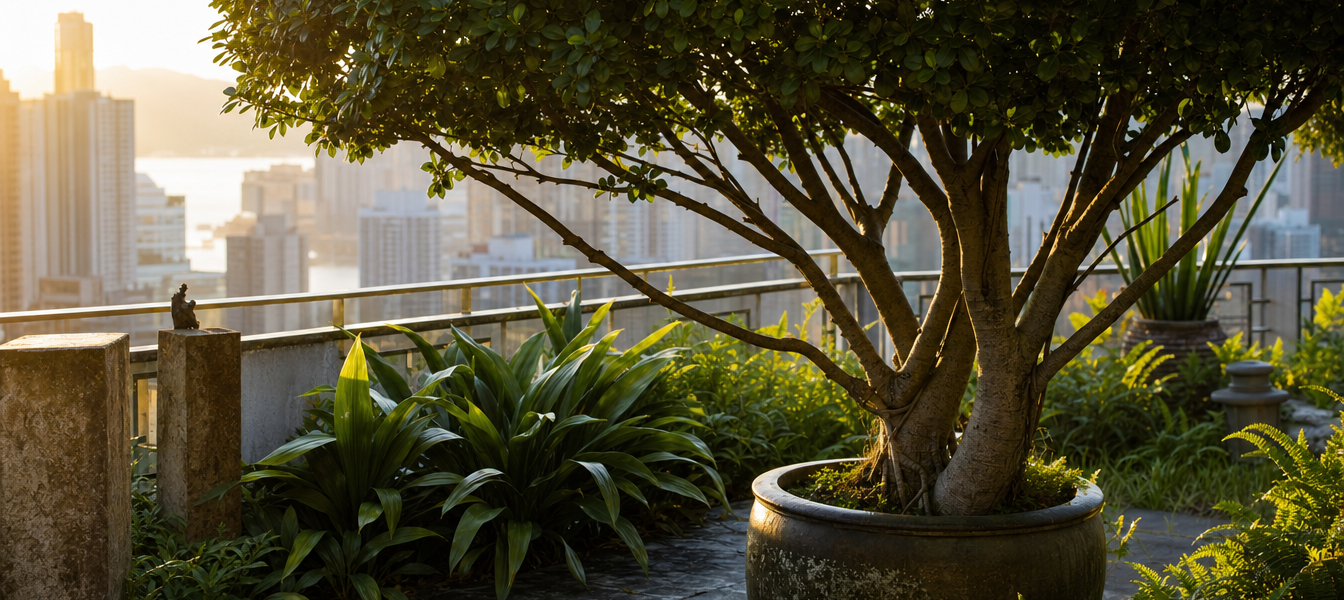
May Cheng has been designing gardens in Hong Kong for eighteen years, which is long enough to have seen the profession transform from a niche service for the wealthy into something that a growing number of people in this city consider essential. She works primarily on roof terraces and small courtyard gardens — the two typologies that define private outdoor space in Hong Kong, where ground-level gardens are rare and those that exist are measured in the tens of square metres rather than the hundreds. Her signature, if she has one, is not a particular plant palette or a preferred material. It is an almost Japanese attention to how light moves through a space across the course of a single day.
“Hong Kong light is difficult,” she tells me, sitting on the roof terrace of her own home in Pok Fu Lam, a space she has been refining for fourteen years. “It is intense but indirect for most of the day because of the buildings. A garden that looks beautiful at ten in the morning can look flat and grey at two in the afternoon because the sun has moved behind the neighbouring tower. You have to design for the light you actually have, not the light you wish you had. That sounds obvious, but it is the mistake I see in almost every garden I am asked to fix.”
For every commission, Cheng creates what she calls a light map — a simple diagram on tracing paper that tracks sun and shadow across the site at three times of day, in both summer and winter. Morning, midday, and late afternoon, plotted for the summer solstice and the winter solstice, overlaid on a plan of the site. “It takes an hour to make, and it changes every planting decision that follows,” she says. “I will not begin a design without one. It is the foundation on which everything else rests.”
The light map reveals what Cheng calls “the golden hour position” — the spot on the site that receives direct, low-angled sunlight between four and six in the afternoon. This is the most valuable real estate in any garden, because it is the place where someone will actually want to sit. “That is where the client’s chair goes,” she says. “Always. It does not matter what the client thinks they want, or where they imagined the seating area would be when they briefed me. The light map tells me where it belongs, and I put it there. Everything else — the planting, the pots, the water feature, the lighting — is composed around that one position. The garden radiates outward from the chair.”
This principle has produced some of the most memorable spaces in Cheng’s portfolio. On a narrow roof terrace in Mid-Levels — forty square metres, three hours of direct sun from eleven in the morning until two in the afternoon — she placed a single Chinese banyan in a large pot at the far end, where it catches the midday light and casts dappled shade across the entire terrace for the rest of the afternoon. The planting underneath is entirely shade-tolerant — aspidistra, ferns, clumps of black-stemmed mondo grass — and the effect is of a woodland clearing suspended forty storeys above Central. The banyan is the garden. Everything else is context.
In a ground-level courtyard in Sheung Wan that receives no direct sun at all — surrounded on all four sides by buildings that rise six storeys or more — Cheng’s solution was a mirror-polished stainless steel water bowl, ninety centimetres in diameter, positioned at the exact centre of the space. “It brings the sky down into the garden,” she says. “The patch of sky visible between the buildings is perhaps two metres square, and during the day it is the brightest thing in the courtyard. The water bowl catches that light and throws it back up into the plants around it. The white hydrangeas, the variegated hostas, the single white-flowered campsis on the wall — they glow against the reflected light in a way they would never do in a sunny garden. The darkness of the courtyard becomes an asset, because it makes the reflected light more dramatic.”
The third garden she describes is a rare example of a Hong Kong garden with full sun — a private villa in Pok Fu Lam with unobstructed exposure from morning to evening. The client expected Cheng to plant for sun. She planted for shade. “In full sun, the most precious thing you can create is shade,” she explains. “Anyone can plant a sunny garden. A garden with full sun and no shade is just a field. The skill is in creating the conditions that make a garden inhabitable.” She used a grove of three Taiwanese rain trees, Koelreuteria elegans, planted close together so their canopies would merge within five years, to create a shaded clearing in the centre of the garden. Beneath them, she planted woodland species — ferns, hellebores, trilliums — that would never survive in open sun. The clearing is the garden’s heart, and it was created not by taking something away but by adding the trees that made it possible.
When I ask Cheng what advice she would give to someone designing their first Hong Kong garden, she pauses for a long moment. “Stop fighting the light,” she says finally. “That is the advice I give to every client, and almost none of them believe me at first. If your garden is shady, plant a shade garden. The most beautiful gardens in the world are shade gardens — the moss gardens of Kyoto, the woodland gardens of England, the fern gullies of New Zealand. A shade garden is not a compromise. It is an opportunity. If your garden is sunny in the morning and dark in the afternoon, put your seating where the morning light is and plant the dark corner with ferns and hostas and let it be dark. The garden that succeeds is the garden that accepts its conditions. The garden that fails is the one that tries to be something it is not.”
She gestures at her own terrace, where the late afternoon light is just beginning to slant across the pots of agave and the single banyan in its terracotta container. “This garden took me fourteen years to get right,” she says. “Not because I am slow. Because a garden is not a painting. It does not stay still. It changes with the seasons, with the years, with the growth of the plants. You cannot design it once and be done. You design it, and then you listen to it, and then you adjust. That conversation — between what you intended and what the garden actually wants to do — is the whole art of gardening. Everything else is just horticulture.”