The Man Who Changed the Way We See Plants
Piet Oudolf is not a household name, unless your household happens to contain a landscape architect. He does not have a television show. He does not write bestsellers. He is a Dutch plantsman in his seventies who lives in a small village called Hummelo, where he has spent forty years breeding and selecting perennials on a nursery that is neither large nor particularly modern. And yet, in the world of garden design, he is the most influential figure of the past half-century. The High Line in New York. The Lurie Garden in Chicago. Hauser & Wirth in Somerset. The Venice Biennale. All Oudolf. All unmistakable. All composed primarily of plants that most people would describe as — and here is the word that makes traditional gardeners uncomfortable — dead.
Oudolf does not design for the flower. He designs for the whole life of the plant: the emerging shoot, the opening bud, the full bloom, the fading petal, the seedhead, the winter skeleton. A garden, in his philosophy, should be beautiful in all four seasons, and the only way to achieve that is to abandon the idea that a garden’s peak is its flowering moment. “A plant is only worth growing,” he has said, “if it looks good when it is dead.” This is not nihilism. It is the most life-affirming idea in contemporary horticulture.
What the New Perennial Movement Actually Means
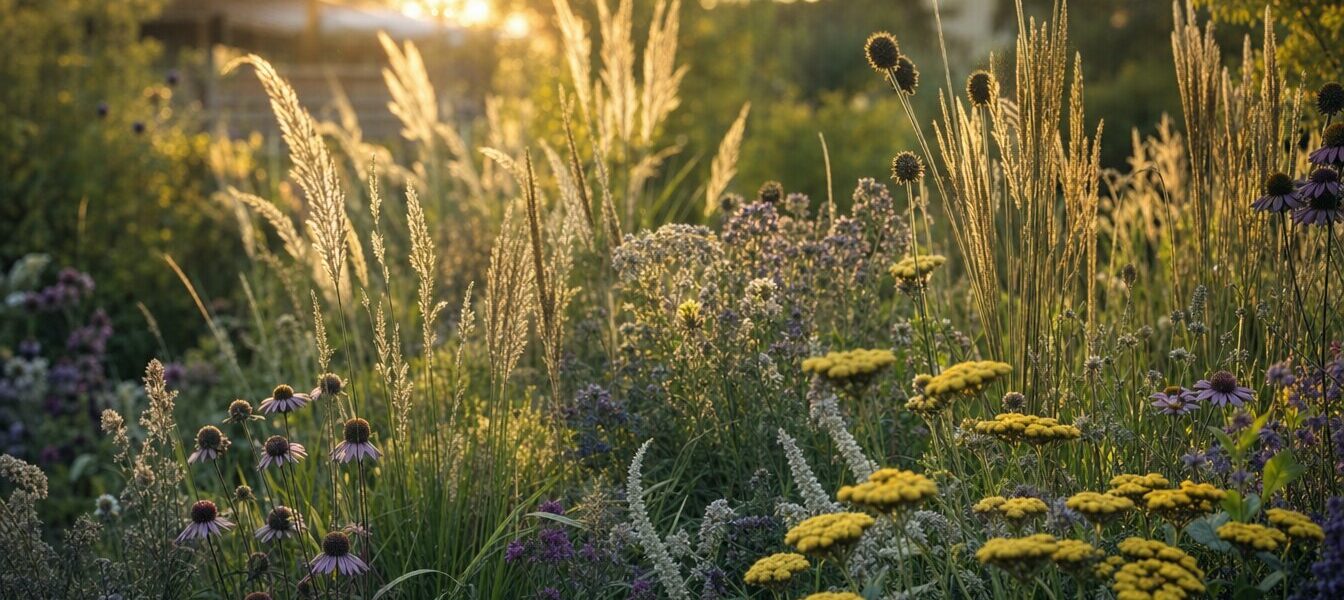
The term “New Perennial Movement” is often reduced to a visual style: grasses, echinacea, rudbeckia, sedum, all planted in loose, drifting masses that look like a meadow designed by a painter. But the movement is not a style. It is an approach. The core principles are ecological, not aesthetic: plant in communities, not as isolated specimens; choose plants for their structural qualities, not just their flowers; design for the whole year, not just the peak weeks of May and June; and never, ever cut everything back in autumn. Leave the seedheads standing. Let the frost catch them.
The movement emerged in the Netherlands and Germany in the 1980s and 1990s, driven by Oudolf and a loose coalition of designers, nurserymen, and ecologists who had grown tired of the labour-intensive, resource-hungry, ecologically sterile model of the traditional European border. They looked to the North American prairie — to the tallgrass communities of the Midwest, where dozens of species coexist in a self-sustaining matrix — and asked: why can’t a garden work like this? Why can’t a garden be both beautiful and ecologically functional? Why must we choose between aesthetics and biodiversity?
The Hong Kong Problem
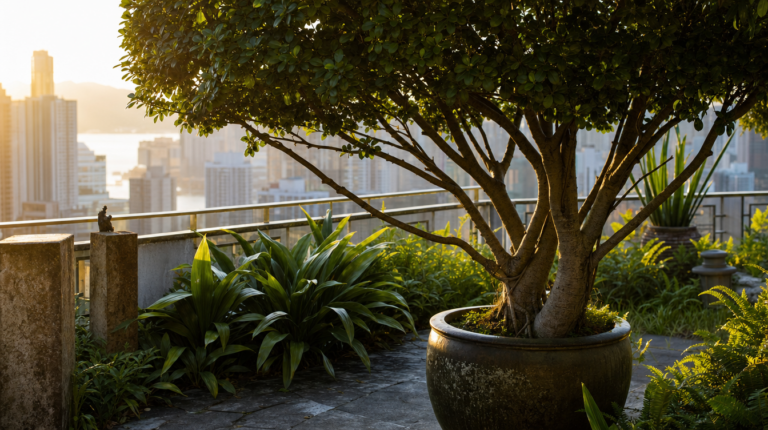
All of which sounds wonderful, until you try to apply it to a subtropical monsoon climate with six months of brutal humidity and a native flora that bears almost no resemblance to the North American prairie. The plants that define Oudolf’s aesthetic — echinacea, rudbeckia, calamagrostis, eryngium, perovskia — are temperate species adapted to cold winters and moderate summers. Plant them in Hong Kong and they will suffer. The humidity will rot their crowns. The lack of winter chill will confuse their dormancy cycles. By August, what was supposed to be a drifting mass of purple and gold will be a patch of brown sludge, and the gardener who planted it will be on the phone to a nursery asking for replacement plants that will meet the same fate next year.
This does not mean the New Perennial philosophy is irrelevant to Hong Kong. It means it needs to be translated. The principles — plant communities, structural selection, year-round interest, ecological function — are universal. The plant palette is not. A Hong Kong perennial garden must be built from species that can handle the climate: native gingers and ferns for the shade layer, tropical grasses like miscanthus and pennisetum for the structural matrix, and flowering perennials drawn from the flora of southern China and Southeast Asia rather than the flora of the Netherlands. The look will be different. The thinking is the same.
The Hong Kong Palette: What Works
If you want to build a perennial planting in the New Perennial spirit that will actually survive a Hong Kong summer, start here. For the structural layer — the plants that hold the composition together through all four seasons — use Miscanthus sinensis (Chinese silver grass, a native), Pennisetum alopecuroides (fountain grass), and Chlorophytum comosum (spider plant, which is much more architectural when grown outdoors in the ground than in a hanging basket indoors). For the flowering layer, try Plumbago auriculata (Cape leadwort, a sprawling shrub that flowers almost continuously in Hong Kong), Salvia leucantha (Mexican bush sage, whose purple-and-white flowers appear in late summer when almost everything else has given up), and Ruellia simplex (Mexican petunia, which is invasive in some parts of the world but well-behaved in a contained Hong Kong border).
For the winter skeleton — the Oudolfian insistence that the garden must look good when it’s “dead” — rely on grasses. Miscanthus in January, bleached to pale gold and backlit by the low winter sun, is as beautiful as anything that flowers. The seedheads of Pennisetum catch the morning dew and hold it for hours, each one a tiny prism. Even the seemingly mundane Liriope muscari (lilyturf), planted en masse as a ground cover, produces spikes of purple flowers in late summer and black berries that persist through winter. It is not a prairie. It is a subtropical interpretation of one. And it works.
The Bigger Question
Oudolf’s real legacy, for Hong Kong and for everywhere else, is not a particular look. It is permission. Permission to let plants complete their life cycles rather than cutting them down the moment a petal drops. Permission to value texture and form and movement as highly as colour. Permission to design gardens that are as beautiful in January as they are in June. Permission to think ecologically rather than decoratively — to see a garden not as a collection of pretty objects but as a functioning community of living things.
That permission is transferable to any climate, any culture, any garden. You do not need echinacea. You need the courage to let things die beautifully. You need the patience to watch a seedhead catch the light for six months until the new growth pushes through from below. You need to believe, as Oudolf does, that a garden’s most honest season is winter, when nothing is hidden and everything is exactly what it is. That belief, once acquired, will change the way you see every plant you grow. It will also change, in ways you cannot predict, the way you see yourself.