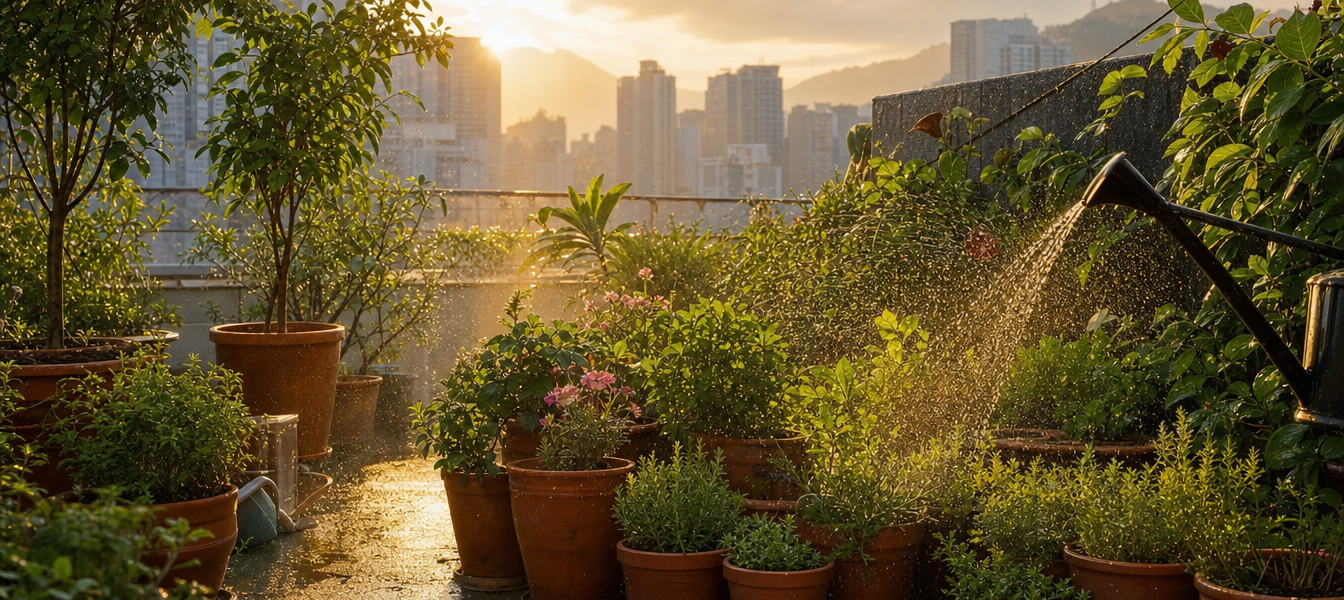
The single most widespread error in gardening is not overwatering, though that kills more houseplants than any other cause. It is not underwatering, though that runs a close second. It is not choosing the wrong plant for the wrong place, planting at the wrong depth, or failing to feed at the right time. The most common mistake, the one that wastes water, promotes disease, and in the hottest months can actually damage the plants it is intended to help, is simpler than any of these. It is watering at the wrong time of day. And almost everyone gets it wrong.
The old advice has been passed down through generations of gardening books with the authority of scripture: never water in the sun, because water droplets on leaves will act like tiny magnifying glasses and burn the foliage. This is a myth. It has been tested in controlled studies — water droplets placed on leaves in direct tropical sunlight, measured for temperature, checked for damage — and the results are unambiguous. Water droplets do not cause leaf burn. The physics does not work that way. The droplet evaporates before it can focus enough light to do any harm, and the cooling effect of evaporation more than offsets any theoretical concentration of sunlight. The old advice is wrong. But the old advice is also right, for the wrong reason, about the wrong problem.
The real problem with watering at midday is not leaf scorch. It is evaporation. Water applied to soil at noon, when the sun is at its highest and the ambient temperature is at its peak, can lose up to forty percent of its volume to the atmosphere before it ever reaches the roots. You are not watering your plants. You are watering the air. The water that does reach the soil is often applied too quickly to penetrate deeply, because the gardener, aware that they are losing water to evaporation, rushes the job. The result is shallow moisture that trains roots to stay near the surface, where they are vulnerable to every heatwave and dry spell that follows. A plant watered at midday is a plant being trained, slowly and systematically, to be weak.
The optimal time to water, according to the accumulated wisdom of horticultural science and the practical experience of every professional gardener I have ever asked, is between four and six in the morning. At this hour, the soil is at its coolest after a full night of radiative cooling. The air is still, so there is no wind to carry water away from its target. The sun is below the horizon or just rising, so evaporation is negligible. And the foliage will have the entire morning to dry before evening — a detail that matters more in Hong Kong’s humidity than in drier climates, because wet leaves at night are an invitation to every fungal pathogen within dispersal distance.
If you cannot water at dawn — and most people cannot, because most people are asleep at dawn or, if awake, are doing things other than standing in their garden with a hose — the next best window is between six and eight in the evening. But this comes with a critical caveat: water the soil, not the leaves. Evening watering that wets the foliage is the worst of all worlds — the leaves stay damp all night, the humidity around the plant stays elevated for hours, and the fungal spores that have been drifting through the air all day finally find the landing pad they have been waiting for. A soaker hose laid at the base of plants and turned on for twenty minutes at dusk is excellent. A sprinkler running at the same hour is an invitation to disaster.
Container plants present a special case that almost no general gardening advice addresses. A terracotta pot in full Hong Kong sun can reach internal soil temperatures of forty-five degrees Celsius by late morning. When you apply cold water from a hose to a root zone that has been baking at that temperature for hours, the thermal shock can damage fine root hairs — the microscopic structures that actually absorb water and nutrients. The plant may not die, but it will sulk. It will stop growing for days while it repairs the damage. The solution is counterintuitive: water container plants twice in the morning, not once. A light watering at six in the morning, just enough to cool the pot and lower the soil temperature by a few degrees. Then, at seven, a deeper watering that penetrates to the full depth of the root zone. The first watering is for the pot. The second is for the plant.
How do you know if you are watering enough? The finger test — push your finger into the soil and feel whether it is moist — is unreliable. It tells you about the top two centimetres of soil, which dry out within hours of watering regardless of what is happening deeper down. A better method, for container plants, is to lift the pot. A dry pot is noticeably lighter than a wet one, and after a week of lifting your pots before and after watering, you will know your plants’ water status by weight alone. It is more accurate than any moisture meter you can buy, and it costs nothing. For plants in the ground, the best tool is a screwdriver. Push it into the soil. If it penetrates easily to a depth of fifteen centimetres, the soil has enough moisture. If it meets resistance before that depth, the soil is dry, regardless of what the surface looks like.
The one rule that changes everything, for gardeners at every level of experience, is this: water deeply and water infrequently. A deep soaking once every three days produces healthier root systems than a light sprinkle every day. Shallow watering trains roots to stay near the surface, where the soil dries fastest and the temperature fluctuates most. Deep watering — at least fifteen centimetres of penetration — encourages roots to grow downward, following the water into the cooler, more stable layers of the soil profile. A plant with deep roots is more drought-tolerant, more wind-resistant, and more resilient to every stress the climate can impose. The extra water you apply in each session is repaid tenfold in the health of the plant.
This is not complicated. None of it requires special equipment or advanced training. It requires only precision — the willingness to learn what your plants actually need, rather than what you assume they need, and to act on that knowledge consistently. In gardening, as in most things, precision is what separates a plant that survives from a plant that thrives. And the difference between surviving and thriving, in a garden, is everything.


