Hong Kong is getting hotter. This is not a prediction; it is a measurement. Average temperatures have risen nearly two degrees Celsius since systematic records began, and the city now experiences more days above thirty-three degrees than at any point in the last hundred years. For gardeners, this is not an abstraction to be debated at dinner parties. It is a design constraint — as real and as binding as the dimensions of a plot or the budget of a client. It demands a fundamentally different planting palette than what worked a decade ago, when a Hong Kong garden could reasonably approximate an English cottage garden with enough irrigation and determination. That garden is no longer viable. Something new is required.
The models that make the most sense for Hong Kong’s emerging climate come not from England or France but from the Mediterranean basin and the coastal regions of Australia. These are landscapes that evolved under conditions of long dry summers punctuated by brief, intense periods of rain — exactly the pattern that is now intensifying across subtropical Asia. The plants that thrive in these conditions share a set of qualities that, when composed with intention, create gardens of extraordinary beauty. They are not gardens of compromise. They are gardens of conviction — every plant chosen because it belongs here, now, in this climate, not because it belonged somewhere else a century ago.
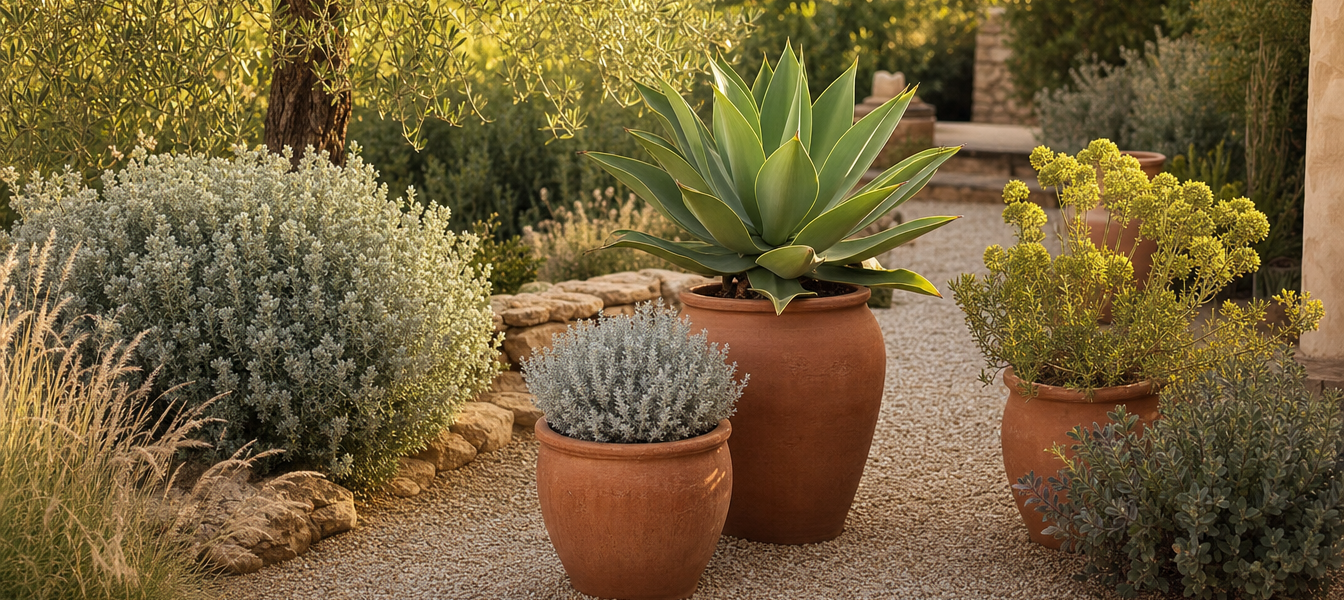
Silver foliage should form the backbone of any dry garden. Plants with grey and silver leaves — lavender, artemisia, santolina, helichrysum, the smaller-leaved forms of teucrium — possess a physiological advantage that reads as an aesthetic one. Their leaf surfaces reflect rather than absorb solar radiation, reducing water loss through transpiration by a margin that can mean the difference between a plant that flourishes and a plant that merely endures. In a Hong Kong context, they also provide the cool-toned relief that makes terracotta and warm stone sing. A metre-wide ribbon of santolina, its silver cushions catching the low afternoon light, creates a far stronger visual anchor than three isolated plants of any colour. Silver foliage is not a novelty. It is the colour field against which everything else in a dry garden plays.
Structural evergreens provide the garden’s architecture — the permanent framework that holds its shape through both the wet season and the dry. Euphorbia characias, with its upright stems, glaucous foliage, and chartreuse flower heads that persist from January through May, is perhaps the most useful plant in this category. It reads as a sculpture even when nothing else is happening in the garden. Westringia fruticosa, the Australian coastal rosemary, is nearly indestructible in Hong Kong conditions — it accepts full sun, salt spray, and neglect with equal equanimity, and it produces small white flowers year-round without being asked. Compact forms of rosemary itself, particularly the prostrate varieties that spill over the edges of raised beds, provide fragrance and structure in equal measure. These are not exciting plants in the way a dahlia is exciting. They are necessary plants in the way a good sofa is necessary — they do the work that allows everything else to flourish.
Gravel, in a dry garden, is not a mulch. It is a design element as important as any plant. A properly laid gravel surface — five centimetres deep over a base of compacted crushed stone — does several things simultaneously. It suppresses weeds without chemicals. It reflects heat upward into the canopy of silver-leaved plants, intensifying their colour and creating the shimmering visual effect that makes Mediterranean gardens so distinctive. It provides a crisp, mineral floor that makes every plant read as a deliberate object on a considered surface. And critically for Hong Kong’s monsoon months, it drains instantly. Water passes through gravel the way it passes through sand — there is no pooling, no mud, no weeks-long recovery period after a heavy rain. A gravel garden is a garden you can walk through barefoot ten minutes after a typhoon.
Terracotta pots deserve a special place in any discussion of dry gardening. Unglazed terracotta is a living material — it breathes. Water evaporates through the porous walls of the pot, cooling the root zone by several degrees below the ambient air temperature through the physical process of evaporative cooling. A grouping of three terracotta pots — large, medium, and small, planted with agave attenuata, sedum, and trailing rosemary — creates a self-contained dry garden microclimate that works on a balcony, a roof terrace, or a courtyard. It is portable. It is modular. It requires nothing more than sun and occasional water. It is, in its way, a perfect piece of garden design.
Irrigation is the dry garden’s secret weapon — but it must be done by design, not by schedule. Drip irrigation laid beneath gravel delivers water directly to roots with effectively zero evaporation loss. Program it for four in the morning, twice weekly during the dry season, and the garden sustains itself without you. This is not cheating. It is engineering. The alternative — dragging a hose around in the midday heat, losing forty percent of the water to evaporation before it reaches the soil — is not virtuous. It is inefficient. The dry garden is not a garden of deprivation. It is a garden of precision — every drop of water accounted for, every plant chosen for its ability to thrive on exactly what the climate provides. That is not a compromise. That is a design philosophy.


