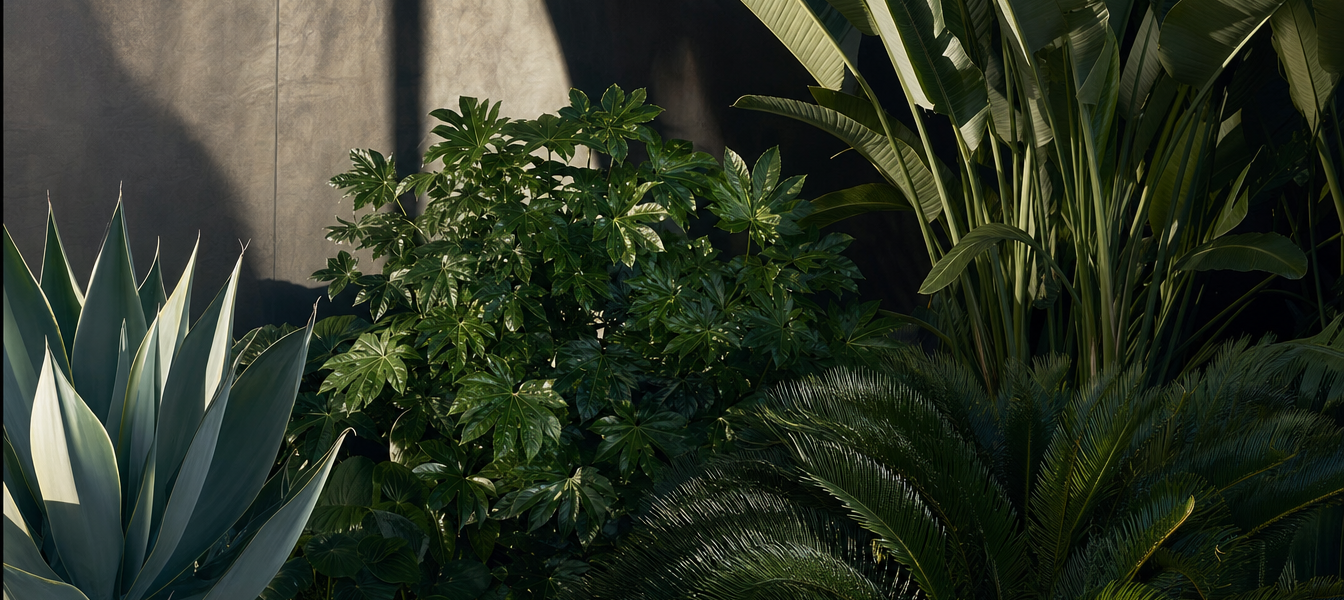
Most people choose plants for their flowers. This is understandable. Flowers are nature’s most extravagant gesture — the rose in June, the wisteria in April, the dahlia in September — and the desire to fill a garden with them is as old as gardens themselves. But a garden designed around flowers alone is a garden that peaks for a few weeks and then collapses into a green confusion. The flowers come and go. What remains, month after month, year after year, is structure — the bones of the garden, the plants whose form and presence hold the composition together when nothing is in bloom. These are the architectural plants. They are not the stars of the garden. They are the stage on which the stars perform. And choosing them well is the single most important decision a garden designer makes.
I asked three garden designers who work regularly in Hong Kong — Jo Thompson, who divides her practice between London and Hong Kong and whose gardens have won gold at Chelsea; Fernando Martos, a Mexico City-trained designer who has built some of the most admired private gardens on Hong Kong Island over the past decade; and May Cheng, whose work on roof terraces and courtyard gardens I have written about elsewhere — to name the plants they return to again and again for their structural qualities. Between them they named dozens. Ten plants appeared on every list. These are the ten.
Agave attenuata, the spineless century plant, is the most sculptural plant available to Hong Kong gardeners — and unlike its spiny relatives, it can be placed in a pot beside a path or a doorway without endangering passers-by. Its rosette of grey-green leaves forms a perfect geometric statement whether planted in the ground or in a container. Martos describes it as a plant that “reads as a design object, not a plant” and believes this changes how people perceive the entire garden. “When visitors see an agave, they stop thinking about gardening and start thinking about design. That shift in perception is worth more than any number of flowers.”
Euphorbia characias subspecies wulfenii is Thompson’s nomination for the plant that taught her that green can be a flower. Its upright stems rise to a metre or more, topped from late winter through spring with broad heads of chartreuse bracts that glow in low light and persist for months. The foliage is glaucous blue-green, providing a cool counterpoint to the warmth of terracotta and gravel. It is evergreen, drought-tolerant, and architectural to its core. “If I could only have one structural plant,” Thompson says, “it would be this one.”
Fatsia japonica, the castor oil plant, solves a problem that defeats most large-leaved plants in Hong Kong: it thrives in shade. Those giant palmate leaves, each the size of a dinner plate, bring instant tropical drama without the maintenance demands of bananas, gingers, or alocasias. It asks for nothing beyond soil that does not dry out completely and shelter from the midday sun. In a shady courtyard, placed against a white wall where its silhouette can be read clearly, it is magnificent.
Miscanthus sinensis, the definitive ornamental grass for Hong Kong conditions, brings verticality and movement to a planting scheme. Its narrow leaves rise in a fountain shape and catch every breeze, animating the garden in a way that static plants cannot. Cheng’s advice is to plant it in odd numbers — three, five, or seven — because “odd numbers always read as more natural. Even numbers look arranged. The difference is subtle, but your eye registers it whether you know the rule or not.”
Ficus microcarpa, the Chinese banyan, is a Hong Kong native that carries the weight of the region’s landscape history. When trained as a standard — a single straight stem topped with a clipped spherical crown — it becomes the most elegant small tree available to local gardeners. Martos calls it “the Hong Kong olive tree” and uses it wherever he needs a formal evergreen presence that reads as belonging to the place rather than imported from Europe. It is slow-growing, which makes mature specimens expensive, but that slowness is part of its character. A banyan does not rush. Neither should the garden around it.
Aspidistra elatior, the cast iron plant, is the ultimate plant for the difficult places — the dry shade beneath a canopy, the narrow strip between a wall and a path, the forgotten corner where nothing else survives. Its broad, dark, lance-shaped leaves provide the ground-level architecture that lifted canopies need. Thompson uses it “like a rug” — planted in generous drifts that define the floor plane of a garden the way a carpet defines a room. It is not a plant you notice immediately. It is a plant you would notice if it were absent.
Strelitzia nicolai, the giant white bird of paradise, provides vertical drama in containers. Its banana-like leaves can reach two metres even when confined to a large pot, creating an instant tropical presence on a roof terrace or beside a pool. “One of these in a large terracotta pot is an entire tropical garden,” Martos says. “You do not need anything else. The scale does the work.”
Cycas revoluta, the sago palm, is not a palm at all but a cycad — an ancient lineage of plants that predate the dinosaurs and carry a prehistoric gravitas that no flowering plant can match. A mature specimen, with its symmetrical rosette of dark green fronds and its textured trunk, anchors a composition the way a piece of heavy furniture anchors a room. Cheng uses them as focal points in minimalist schemes where a flowering plant would read as fussy. “It is the antithesis of a dahlia,” she says, “and sometimes that is exactly what a garden needs.”
Trachelospermum jasminoides, the star jasmine, is the structural climber — the plant that covers walls, frames doorways, and perfumes the garden for two months of the year while asking almost nothing in return. Trained on a simple wire framework against a brick wall, it creates a living tapestry whose dark green leaves provide a permanent backdrop for whatever seasonal planting sits in front of it. The flowers, when they come in late spring, are small white stars with a fragrance that carries for metres. They last six weeks and then they are gone. But the foliage remains, doing its structural work, month after month, year after year.
The final entry on every designer’s list is bamboo — but only of a specific kind and only in a container. Running bamboo, the kind that spreads by underground rhizomes and can colonise a garden in a single season, is a menace that no responsible designer will plant anywhere near a garden. Clumping bamboo is different. Bambusa multiplex “Alphonse Karr,” with its pink-and-green striped culms that catch the light like polished stone, is spectacular in a large pot. It provides height, movement, and the distinctive rustling sound that is one of the pleasures of any garden that contains it. “A pot gives you the architecture without the invasion,” Thompson says. “It is the only way to use bamboo responsibly, and when you do, it is worth the effort.”
These ten plants are not the most exciting plants in the world. They will not produce the biggest flowers or the most dramatic seasonal displays. What they will do, year after year, is provide the framework that allows everything else in the garden to make sense. They are the grammar of the garden — invisible when they are doing their job, glaringly obvious when they are missing. Choose them first. Plant them well. And then, and only then, add the flowers.


