The Fear
Every gardener has stood in front of a plant with a pair of secateurs and frozen. The rose that has grown too tall. The hydrangea that has become a tangled mess. The fruit tree that produced nothing last year and probably won’t produce anything this year either, but — what if cutting that branch is the wrong decision? What if the plant dies? What if you ruin it? The fear of pruning is universal and primitive. It feels like mutilation. It feels like you are hurting something that trusts you.
You are not. Pruning is not violence. Pruning is information. When you cut a stem, you are not punishing the plant — you are telling it, in the only language it understands, where to direct its energy. A pruned plant is not a wounded plant. It is a plant that has been given a map.
Why Pruning Works (the Five-Minute Botany Lesson)
At the tip of every growing stem sits a cluster of cells called the apical meristem. This is the plant’s command centre. It produces a hormone called auxin, which flows downward through the stem and suppresses the growth of side buds — a phenomenon botanists call apical dominance. The plant’s strategy, in evolutionary terms, is to grow up. Up toward the light, up above the competition, up at the expense of everything else. It is a good strategy, if you are a plant in a forest. It is a terrible strategy if you are a plant in a garden, where you do not need to outrun your neighbours and where a tall, lanky, single-stemmed specimen is not what the gardener had in mind.
When you prune the tip of a stem, you remove the auxin-producing meristem. The side buds — which have been waiting, dormant, for exactly this signal — are released from suppression. They begin to grow. Where there was one stem, there will soon be three or four. The plant becomes bushier, fuller, more floriferous. You have not harmed it. You have told it to change its shape, and it has complied. This is not magic. It is developmental biology, and it works on every plant in your garden.
The Calendar
Winter (December–February). This is the season for structural pruning — the big cuts that define the shape of a plant for the year to come. Deciduous trees and shrubs are dormant, their leaves gone, their architecture visible. You can see exactly what you are doing. Cut out anything that crosses, anything that rubs, anything that points inward. Remove dead wood at its base. Shorten last year’s growth by a third to a half, cutting just above an outward-facing bud. The exceptions: spring-flowering shrubs like camellia and azalea should NOT be pruned in winter, because they have already set their flower buds. Prune them immediately after they finish blooming instead.
Spring (March–May). The season of the light touch. Pinch out the growing tips of soft-stemmed plants — basil, chrysanthemum, dahlia — to encourage bushiness. Deadhead spring bulbs as the flowers fade, but leave the foliage to die back naturally; the leaves are recharging the bulb for next year. If you have roses, this is the moment for the first major feed and the beginning of the deadheading regime that will keep them blooming through summer.
Summer (June–August). Prune as little as possible. The plant is working at full capacity — photosynthesising, flowering, fruiting — and every cut is a stressor. The exceptions: deadheading (remove spent flowers before they set seed, and many plants will produce a second flush); removing diseased or pest-damaged growth immediately (bag it, don’t compost it); and light thinning of overly dense foliage to improve air circulation, which reduces fungal disease in Hong Kong’s humid summers.
Autumn (September–November). The second major pruning window. As the heat breaks, give summer-flowering shrubs their annual cutback. Hibiscus, bougainvillea, lantana — all respond well to a hard prune in early autumn, which gives them time to produce new growth before the cool season slows everything down. This is also the time to divide overgrown perennials and to cut back herbaceous plants that have finished their season.
The Three Cuts (and the One You Must Never Make)
There are only three cuts you need to know. The first is the heading cut: snip a stem just above a bud, at a forty-five-degree angle sloping away from the bud, so water runs off the cut surface rather than pooling against the bud. The second is the thinning cut: remove an entire stem or branch at its point of origin, flush with the trunk or the larger branch it emerged from. The third is the deadheading cut: remove a spent flower just above the first set of healthy leaves below it.
And the one cut you must never make? The stub. A cut that leaves a short length of stem protruding beyond the nearest bud or branch junction. The stub will die back. The dieback will invite disease. The disease will travel down the stem and into the heart of the plant. If you are going to make a cut, make it clean, make it decisive, and make it at the right place. A stub is not caution. It is cruelty.
Tools That Earn Their Place
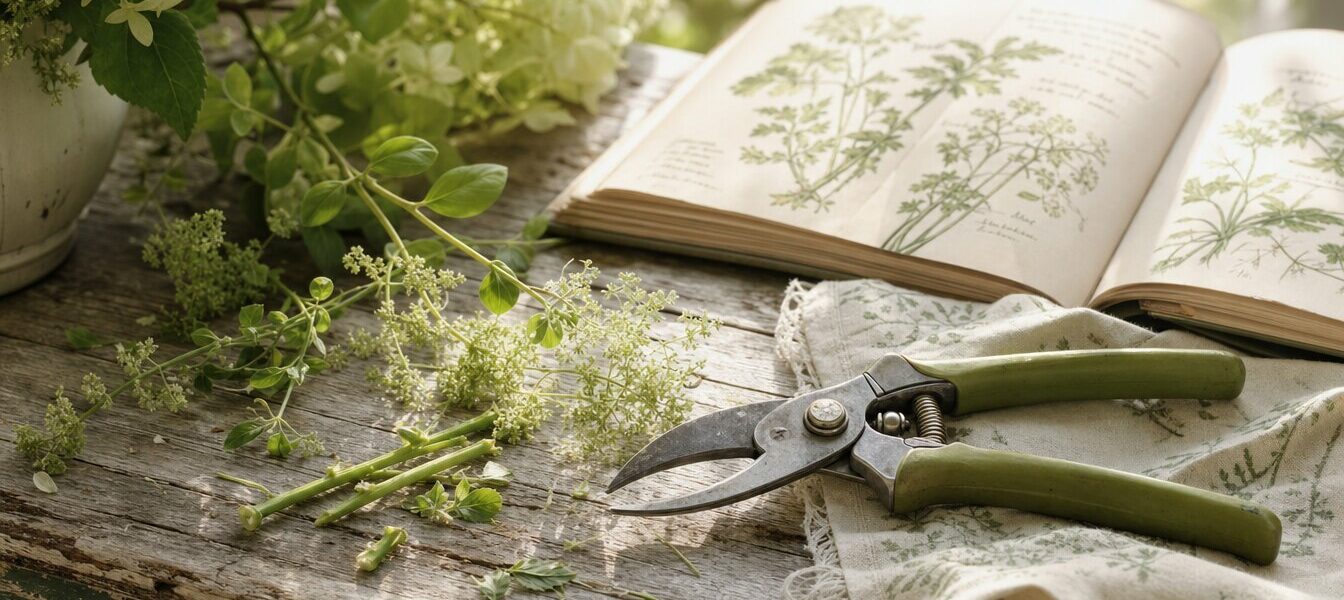
You need exactly three tools to prune anything in a domestic garden. A pair of bypass secateurs — the kind where the blade slides past the anvil like a pair of scissors, not the kind where the blade crushes against a flat surface. Bypass secateurs make clean cuts that heal quickly; anvil secateurs crush the stem and leave a wound that takes longer to close. Spend at least three hundred Hong Kong dollars on them, and they will last a decade. A pair of loppers, for anything thicker than your thumb. And a folding pruning saw, for anything thicker than your wrist. That is it. You do not need electric hedge trimmers. You do not need pole saws. You do not need the gadget that promises to prune your roses with a laser. You need a sharp blade and the confidence to use it.
Sharpen your secateurs at the start of every season. Clean them with methylated spirits between plants, especially if you suspect disease. A dirty blade is a vector. A sharp blade is a pleasure. The difference between a task and a ritual is often just the condition of the tool.
The Confidence to Cut
If you take nothing else from this article, take this: you will not kill a healthy plant by pruning it. Plants are not fragile. They have survived herbivores and storms and fires and ice ages. They can survive your secateurs. The worst that can happen is that you make an ugly cut, and the plant responds with a burst of new growth that gives you another chance to get it right. The best that can happen is that you transform a leggy, sparse, underperforming specimen into the plant you always knew it could be. The only way to learn is to do it. So go outside. Pick up your secateurs. Find a plant that needs a haircut. And cut.


