The Mistake
Every novice gardener makes the same mistake. They buy plants first. They come home from the nursery with a car boot full of impulse purchases — a camellia they couldn’t resist, a hydrangea in a colour they have never seen before, three pots of something labelled “assorted perennials” that were on sale — and then they stand in the middle of their garden, looking at the bare earth, trying to figure out where everything goes. The result, nine times out of ten, is a garden that feels like a collection of pretty objects rather than a designed space. The plants are lovely. The garden is incoherent.
The mistake is understandable. Plants are exciting. Hardscaping — the paths, walls, terraces, steps, pergolas, and water features that form the bones of a garden — is not. Hardscaping is expensive. Hardscaping is permanent. Hardscaping requires a skip, a cement mixer, and several weekends of back-breaking labour. It is the vegetable course of garden design: necessary, nourishing, and completely unglamorous. But it is also the thing that separates a garden from a flower bed. A garden without hardscaping is a sentence without punctuation. The words may be beautiful, but nobody can tell where one thought ends and the next begins.
The Principle of Bones
The great English garden designer Russell Page, who spent sixty years making gardens for the rich and famous across Europe and the Middle East, wrote in his 1962 memoir The Education of a Gardener that “the bones of a garden are its paths, its walls, its changes of level, its water. If the bones are good, the garden will be good, even in winter when there is nothing else to look at. If the bones are bad, no amount of planting will save it.” Page was not being provocative. He was being precise.
Consider the garden in January. The flowers are gone. The deciduous trees are bare. The herbaceous perennials have been cut back to the ground. What remains is the hardscaping: the path that leads from the terrace to the gate, the low stone wall that separates the dining area from the lawn, the flight of steps that descends to the lower garden, the still surface of the pond reflecting the grey winter sky. A garden with good bones is beautiful in January. A garden without them is just mud.
Start with the Path
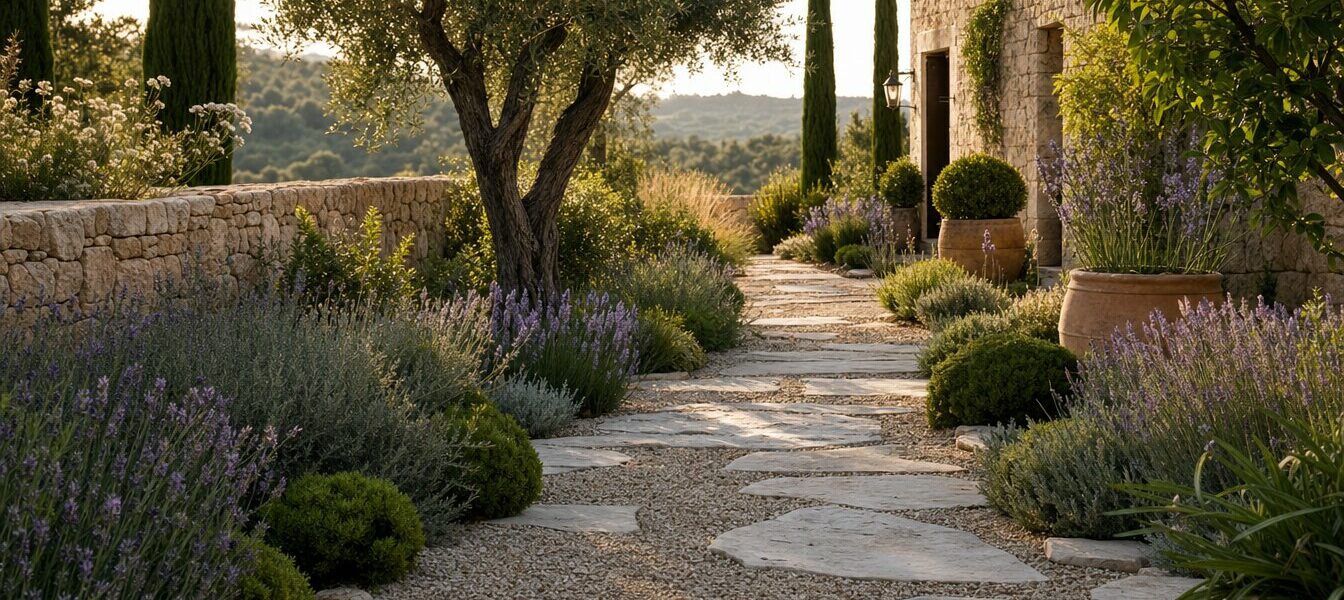
The path is the first and most important hardscaping decision you will make. It dictates how people move through the garden, what they see and in what order, where they pause and where they hurry. A straight path from the front door to the back gate says: this garden is a corridor, a place to pass through. A curving path that disappears around a corner says: this garden is a journey, a place to explore. The difference is not in the planting. It is in the geometry of the ground.
For a domestic garden in Hong Kong, where space is at a premium and heavy rainfall is a fact of life, the ideal path material is gravel stabilised with a honeycomb grid system. It drains instantly — no puddles, no slippery algae — and the crunch of gravel underfoot is one of the most satisfying sounds a garden can produce. If you have the budget, use York stone or reclaimed granite slabs set in gravel, which gives you a solid walking surface with permeable joints. Avoid poured concrete. Avoid decking. Concrete is unforgiving and decking is a maintenance nightmare in the subtropics, where it rots or grows mould or both, usually within three years. Gravel and stone are forever.
Walls, Levels, and the Illusion of Space
A change of level is the cheapest way to make a small garden feel larger. The human eye reads a flat rectangle as exactly what it is: a flat rectangle. The same eye, confronted with a terrace that steps down to a lower area, reads the space as larger than its actual dimensions, because the brain interprets the change of level as a transition between two distinct spaces rather than one continuous one. You do not need a major excavation. A single step — one course of bricks, one row of stone — is enough to create the illusion. The step says: here, something different begins.
Walls serve the same function vertically. A low wall — waist height or below — defines a boundary without closing the space in. It says: this area is the dining area. That area is the garden. The distinction is psychological, but it is real. The wall also provides a vertical surface for climbing plants, which is the most efficient way to add greenery to a small garden without consuming any ground space. A star jasmine on a south-facing wall will cover three square metres within two years and cost you nothing in floor area. That is the kind of calculation that matters when your entire garden is the size of a parking space.
Water: The Sound of Arrival
Every garden should have water. Not a pond — ponds are high-maintenance and mosquito-prone in the subtropics — but a simple recirculating water feature: a stone basin, a bamboo spout, a hidden pump, and a loop of flexible tubing. The cost is a few hundred Hong Kong dollars. The effect is transformative.
Water does two things in a garden. First, it masks noise. The sound of running water is what acousticians call “broadband” — it contains energy across a wide range of frequencies — which means it can cover the rumble of traffic, the drone of air conditioners, and the neighbour’s television without being loud enough to notice. Your brain registers the garden as quieter than it actually is, even though the water feature has added sound, not removed it. Second, water attracts wildlife. Within a week of installation, you will have birds drinking from the basin. Within a month, you will have dragonflies. Within a season, the water feature will have become the centre of the garden’s ecology: a watering hole for the small creatures that make a garden feel alive.
Planting Last
Once the paths are laid, the walls built, the levels defined, and the water running — then, and only then, do you think about plants. This is the part that surprises novice gardeners: if the hardscaping is right, the planting is almost easy. The structure tells you where things go. The path edge needs a low ground cover — plant it. The south-facing wall is bare — train a climber up it. The water feature needs a backdrop — place a sculptural shrub behind it. The decisions that once felt paralysing — where does this go? what goes next to it? — have been answered by the bones of the garden before you even pick up a trowel.
The plants are the clothes. The hardscaping is the body. Dress the body however you like — change it seasonally, experiment, make mistakes and correct them — but never neglect the body itself. A well-proportioned garden with strong bones will look good even when the plants are failures and the flowers have failed to appear. The reverse is never true. No amount of planting can rescue a garden that has no structure. Build first. Plant later. This is the first rule. It is also the only rule that matters.


