When an interior designer furnishes a room, they think about the conversation between objects. A sofa does not exist in isolation. It talks to the coffee table, which talks to the rug, which talks to the pendant light, which talks to the ceiling height. Every piece is in dialogue. The skill of the designer lies not in choosing beautiful things — anyone with a credit card can choose beautiful things — but in orchestrating the relationships between them. A room that works is not a collection of objects. It is a composition.
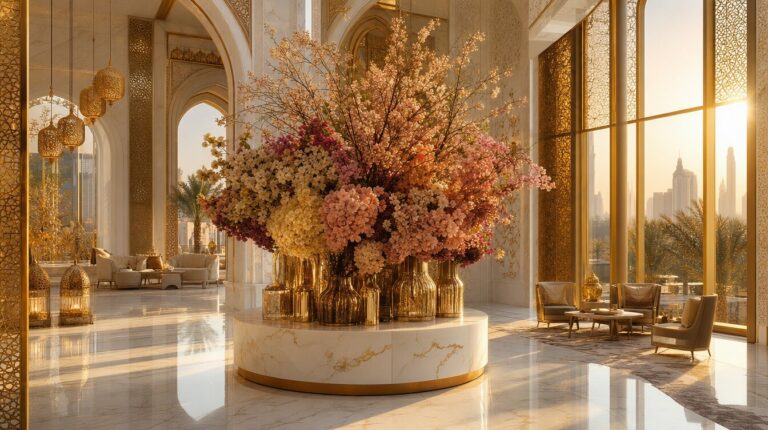
Why, then, do we treat flowers differently? Why do we bring a bouquet home, drop it into whatever vase happens to be clean, push it to the centre of the dining table, and consider the job done? A flower arrangement occupies physical space. It commands visual attention. It either harmonises with the objects around it or it clashes with them. It is, in every meaningful sense, a piece of furniture — temporary, living furniture that changes day by day, but furniture nonetheless. Treating it as decoration is the fastest way to make it look like an afterthought. Treating it as a design object changes everything.
This insight arrived, as insights often do, from the wrong direction. I was not thinking about flowers at all. I was thinking about a ceramicist I knew in Kyoto who made vessels that were too beautiful to put anything in. His vases were complete objects — you could place one on a shelf, empty, and it would hold the wall. The idea that you might put flowers in them seemed almost vulgar, like putting a cushion on a Brancusi. And yet, he told me, he made them specifically for flowers. He just expected the flowers to earn their place. He expected the arrangement to be as considered as the vessel. He expected the flower and the vase to be one thing, not two things with an awkward gap between them.
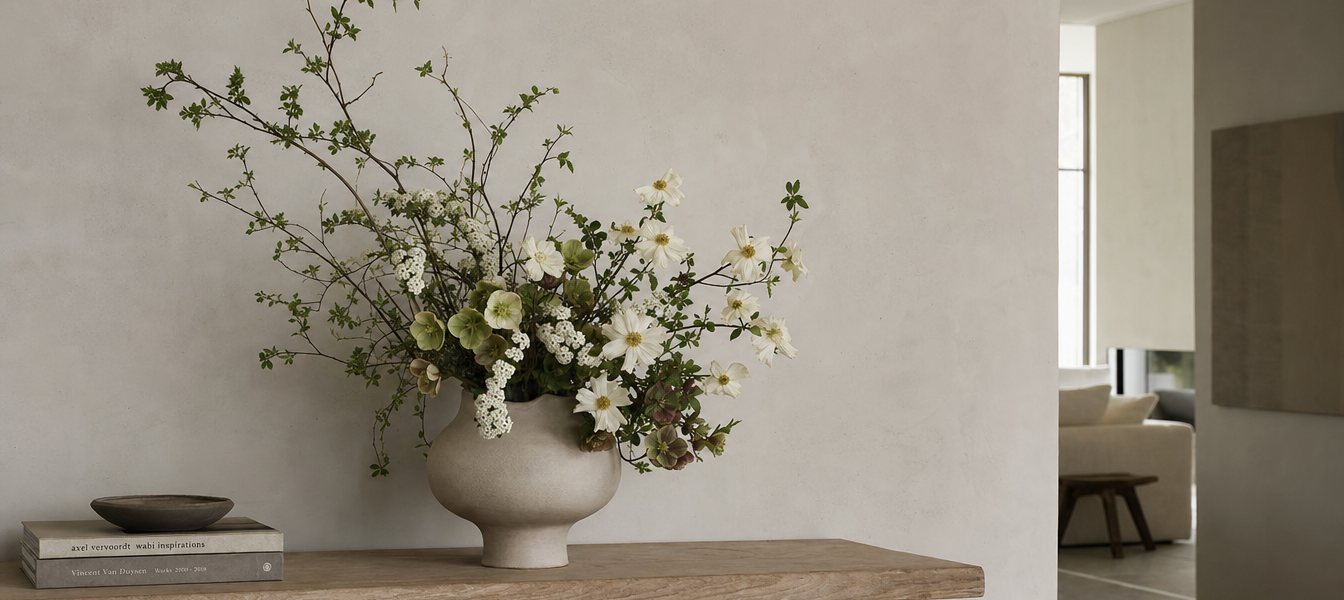
This is the principle behind The Object, the collection we developed at Attic Lifestyle — a series of complete design objects, each consisting of a vessel and an arrangement conceived together, designed to arrive ready to place on a console, a mantel, or a bedside table. No additional vase hunting required. No guesswork about stem height or proportion. Just a considered object, occupying space the way a lamp or a sculpture occupies space, contributing to the composition of the room it enters.
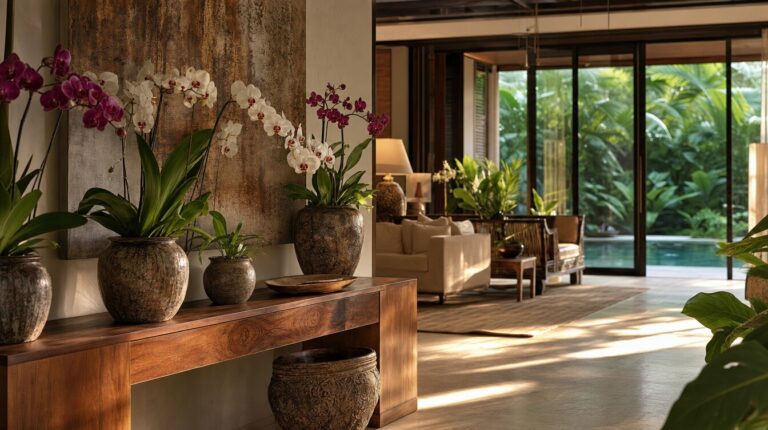
The design process is the same process an interior designer would use for any object. First, you define the site — where will this arrangement live? A low console table demands a low, wide arrangement; a tall narrow mantel demands verticality. Second, you define the relationship — what is the arrangement in dialogue with? If it sits beneath a painting, the colours must respond to the painting. If it sits beside a lamp, the scale must balance the lamp. Third, you choose the vessel — not as a container for the flowers but as a formal element in its own right, with its own weight, texture, and presence. Fourth, and only fourth, you choose the flowers — and you choose them not for their beauty in isolation but for their ability to complete the composition.
This is not how most people approach flowers. Most people start with the flowers — they see something beautiful at the market and buy it — and then scramble to find a vessel and a location that will accommodate their impulse purchase. The result is an arrangement that looks like what it is: a beautiful thing dropped into an unprepared context. The flowers may be lovely. The context may be lovely. But the relationship between them is an accident. And accidents, in design, rarely produce coherence.
The discipline of treating flowers as design objects also changes what you are willing to pay for them. If a bouquet is decoration — a perishable, disposable splash of colour — then it is hard to justify spending more than the cost of a modest lunch. But if an arrangement is a temporary piece of furniture for your home, one that will occupy a prominent position for a week or ten days and define the character of the room it inhabits, then the calculation shifts. You pay for a lamp. You pay for a rug. You pay for a piece of art. Why would you not pay for an arrangement — one that was designed for its specific location, that was composed with attention to scale and proportion and colour, that will change daily as the flowers open and fade — with the same seriousness?
The best flowers are not decorations. They are not the thing you add when everything else is done, to make the room look finished. They are integral to the room from the start. They are the final object in the composition, the one that brings the other objects into focus. A room without flowers is not unfinished in the way a room without chairs is unfinished. It is unfinished in the way a sentence without a full stop is unfinished. The thought is there. The grammar is there. But it does not land. The flowers make it land.