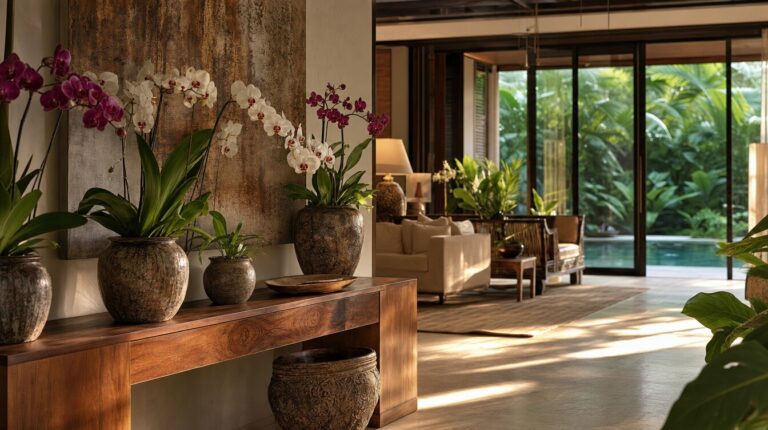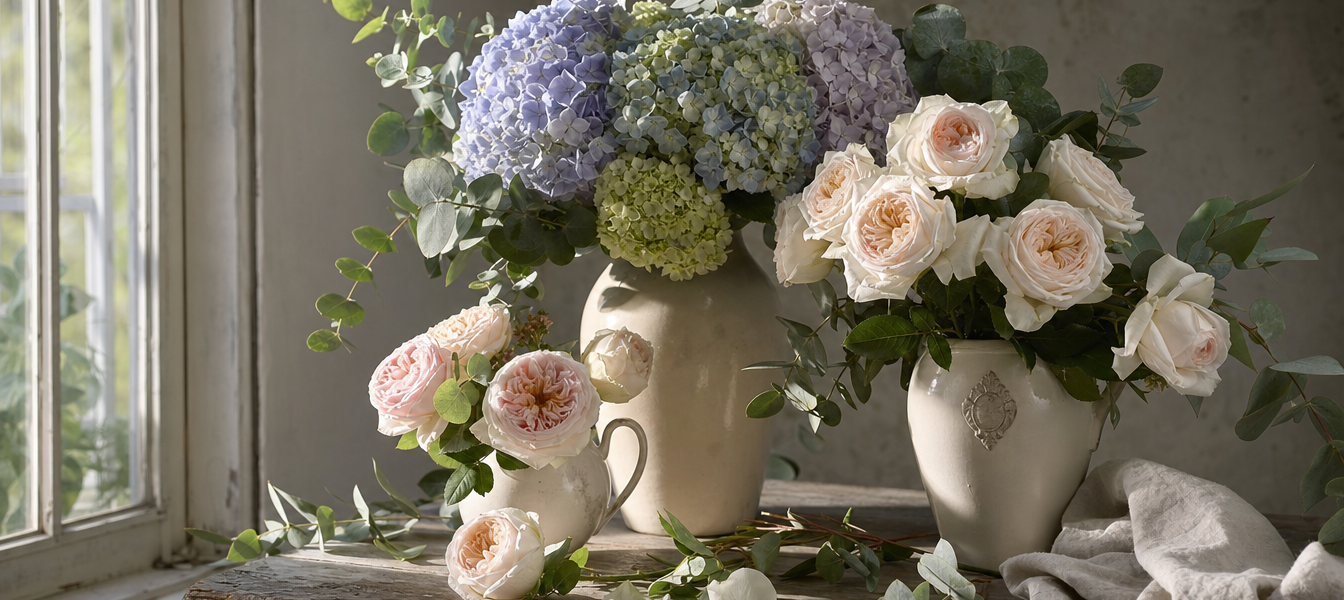
A vase of flowers you bought from a shop is a product. You chose it, you paid for it, you brought it home, and for the next five to seven days it will sit on your table performing the role of decoration with the impersonal efficiency of something that was grown for exactly this purpose. A vase of flowers you cut from your own garden is something else entirely. It is a relationship. You watched those stems grow — you saw the bud form, swell, and break — and you chose the precise morning when they were ready to be cut. You brought them inside in a vessel you already owned, a vessel that has its own history in your home, and you placed them on a surface you walk past twenty times a day. That arrangement is not decoration. It is evidence. Evidence that you made something grow. Evidence that the season is changing. Evidence that there is a garden outside, however small, and you are connected to it.
The difference between the bought bouquet and the garden cutting is not just sentimental. It is technical. A bought bouquet has been conditioned — treated with commercial preservatives, transported in refrigerated trucks, held at precise temperatures and humidities — to maximise vase life at the expense of everything else. It will last a predictable number of days and then it will die, and you will throw it away without ceremony. A stem you cut yourself has had none of this treatment. It is still alive in the truest sense — its cells are still respiring, its stomata are still opening and closing in response to light, its vascular system is still pumping water upward from the cut end. This aliveness is what makes a garden cutting so beautiful in the first few hours after it comes inside. It is also what makes it so unforgiving of poor technique.
The single most important rule of cutting — the rule that professionals observe and amateurs ignore, and that accounts for most of the difference in vase life between them — is to cut in the early morning. At dawn, a plant’s vascular system is fully pressurised. The stomata have been closed all night, so no water has been lost to transpiration. The stem is turgid, rigid, and saturated with water from root to tip. This is the moment when the plant is at its physiological peak, and it is the moment when a cut stem has the best chance of surviving the transition from garden to vase. Cut the same stem at midday, when the plant has been losing water to the sun for hours, and you are starting with a dehydrated specimen. It may recover. It may not. But you have made its job harder before it has even left the garden.
The second rule is to condition properly, and conditioning means water. As soon as a stem is cut, air begins to enter the exposed xylem vessels — the microscopic tubes that conduct water upward through the plant. If that air reaches the leaves before the stem is placed in water, the vessels can become permanently blocked by air embolisms, the botanical equivalent of the bends. The stem will wilt and never recover, regardless of how much water you give it afterward. The solution is simple and absolute: recut every stem underwater. Fill a bowl with clean water, hold the stem beneath the surface, and make a fresh cut at a forty-five-degree angle with sharp, clean secateurs. The water seals the cut, preventing air from entering the vessels, and the stem can begin drawing water immediately. This adds thirty seconds to the process and can add five days to the vase life.
Different flowers demand different treatments, and learning these treatments is part of the pleasure of the cutting garden. Hydrangeas, those blowsy summer beauties that wilt so dramatically when they are unhappy, should be cut when the flower heads feel papery rather than soft to the touch — a sign that the individual florets have matured enough to last in water. Strip every leaf that would sit below the waterline in the vase, because submerged leaves rot within forty-eight hours and the bacteria they release will clog the stem ends. Then sear the cut stem over a flame for ten seconds. This sounds medieval, but the science is sound: the heat denatures the proteins in the sap, preventing them from sealing the cut and blocking water uptake. A hydrangea treated this way will last a week. A hydrangea simply dropped into water will wilt by the following afternoon.
Garden roses should be cut when the buds are one-third to one-half open. A fully open rose has perhaps two days of vase life remaining. A rose cut at the right stage will continue to open over the following three or four days, each day revealing a slightly different version of itself, and the arrangement will change as you watch it. This is one of the pleasures of garden roses that no bought bouquet can replicate — the bought rose was cut at exactly the right stage, shipped, and is now frozen at its peak. It will not change. It will simply fade. The garden rose, by contrast, performs its entire life cycle in your living room, and the performance is worth the price of admission.
Foliage deserves more attention than most cut-flower guides give it. Eucalyptus, ruscus, pittosporum, and the new growth of any shrub with interesting leaf colour — photinia “Red Robin,” coprosma, the bronze-tipped leaves of nandina — will outlast any flower in a vase. An arrangement of foliage alone, five stems of different leaf shapes in a simple glass cylinder, often reads as more considered than a mixed flower bouquet. Foliage provides the architecture of the arrangement, the permanent framework that holds its shape while the flowers come and go. Treat it as a material in its own right, not as filler.
The vessel, finally, matters as much as the flower — not because an expensive vase produces a better arrangement, but because the vessel and the flower are a single composition. A single stem of agapanthus in a tall, narrow glass cylinder is a sculpture. The same stem in a squat jam jar is a weed. The difference is not the flower. It is the proportion, the scale, the visual weight of the container relative to what it contains. The most useful vessels in any cutting garden are three: a tall glass cylinder of thirty centimetres or more, for single stems and tall arrangements; a matte ceramic bowl in cream or charcoal, for low, wide arrangements; and a collection of small bud vases — the kind that hold exactly one stem — for the moments when you have exactly one perfect stem and the wisdom to leave it alone. With these three types of vessel, you can arrange anything the garden produces.
One final rule: use odd numbers. Three stems, five stems, seven. Odd numbers create asymmetry, and asymmetry creates the impression of natural growth — the sense that the arrangement happened rather than being assembled. Even numbers look deliberate, and deliberate, in a flower arrangement, reads as stiff. The difference between “I bought this” and “I grew this” often comes down to whether the stem count is odd or even. It is a small thing. But small things, in flower arranging, are the only things that matter.