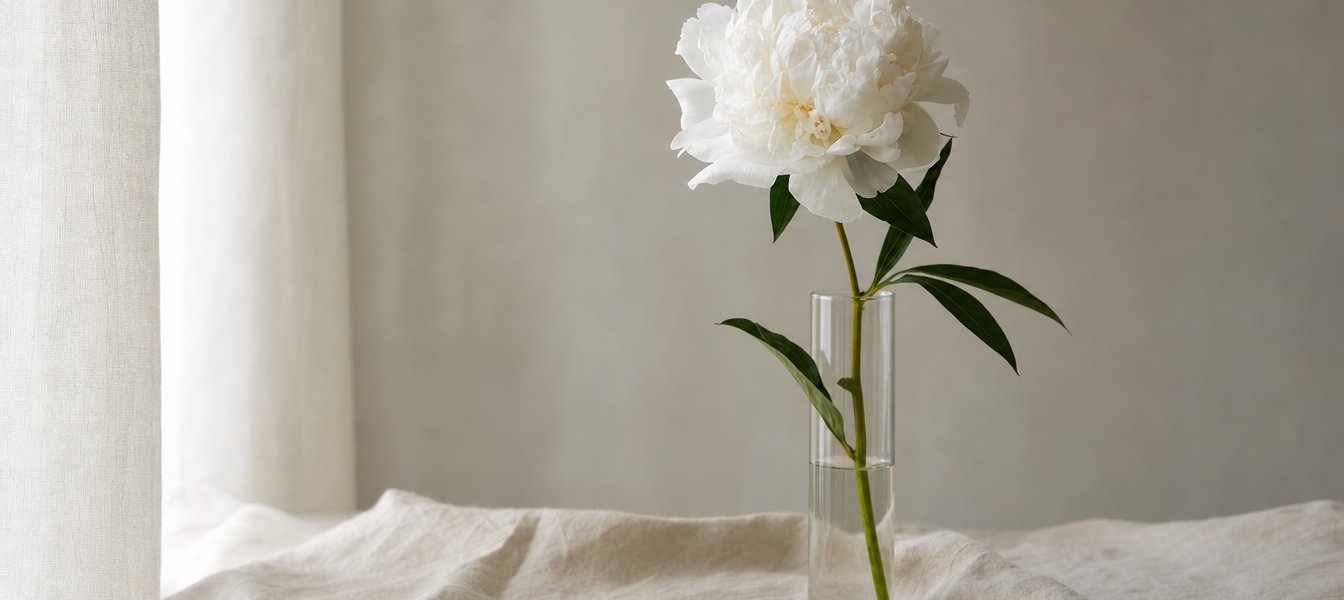
There is a peculiar kind of discipline required to place a single stem in a vessel and call the arrangement finished. It goes against every instinct the amateur flower arranger possesses. The hand wants to add. The eye, trained on supermarket bouquets and wedding centrepieces, has learned to equate abundance with value. More flowers, the thinking goes, must mean more beauty. It takes years to unlearn this. It takes even longer to understand that a single stem, chosen with intention and placed with precision, carries more visual weight than a dozen stems arranged without thought.
I first encountered this idea not in a floristry studio but in a ceramics workshop in Sheung Wan. The potter, a Japanese-trained Hong Kong artist named Agnes Lam, had exactly one vessel on display in her gallery that afternoon — a matte charcoal bottle, perhaps thirty centimetres tall, with a neck so narrow it could accommodate exactly one stem. In it she had placed a single branch of winter-flowering cherry, the buds still tight and pink, the line of the branch tracing a perfect diagonal across the white wall behind it. I stood in front of that arrangement for ten minutes. I have thought about it regularly for the five years since.
What Lam understood — what the Japanese tradition of ikebana has understood for centuries — is that the space around a flower is as important as the flower itself. The single stem frames the negative space, and the negative space, in turn, frames the stem. The two are in dialogue. Remove either and the composition collapses. Add a second stem and the dialogue becomes a conversation, then an argument, then noise. The single stem is not about minimalism for its own sake; it is about giving the viewer exactly one thing to look at, so they might actually see it.
This principle extends beyond flowers. A room with one good chair reads as more considered than a room with six mediocre ones. A garden planted with three species in generous drifts reads as more intentional than a garden with thirty species dotted about like confetti. The single stem is a metaphor for a broader philosophy of design — one that values precision over accumulation, presence over profusion, and the courage to stop before you have done too much.
In practical terms, the single-stem arrangement demands two things from its maker. The first is a good vessel — and “good” here does not mean expensive. It means a vessel with enough visual weight to anchor a single stem. A tall glass cylinder works. So does a heavy ceramic bowl, a narrow-necked bottle, or even a laboratory flask. The vessel must have presence because it carries half the composition. The second requirement is a stem with character — a line that moves, a bud that promises, a leaf that catches the light. Straight stems are boring alone; curved stems, branching stems, stems with a twist or a kink or an unexpected asymmetry — these are the ones worth isolating.
Conditioning matters more with a single stem than with a crowd. In a crowded arrangement, if one stem wilts, the others carry on. In a single-stem arrangement, there is nowhere to hide. Cut in the early morning, when the plant’s vascular system is fully pressurised with water. Recut the stem underwater to prevent air embolisms from blocking the xylem. Strip any foliage that would sit below the waterline, where it would rot and foul the water within 48 hours. Place the vessel somewhere the light will find it, ideally against a plain wall, and then leave it alone. Do not fuss. Do not adjust. The stem knows what it is doing.
The single stem is not easy. It exposes every decision — the choice of flower, the choice of vessel, the angle of the cut, the height of the water — to scrutiny. There is no foliage to conceal a clumsy placement, no mass to distract from a poor proportion. This is precisely why it matters. The single stem is the arrangement that asks: do you trust your own eye? If you can answer yes, and the stem on your table proves it, then you have learned something that applies to every arrangement you will ever make. You have learned when to stop.


